About Cuteland
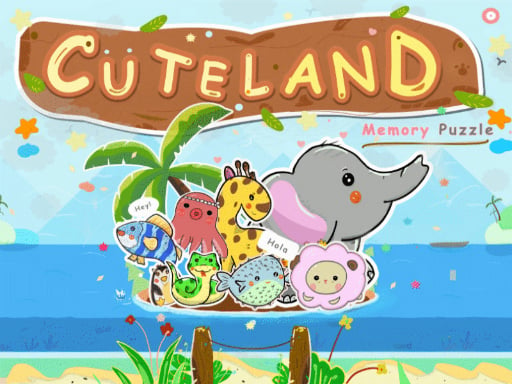
Cuteland is a casual 2D memory puzzle game where players reveal hidden cards, memorize where each image sits on the board, and match identical pairs. Designed with an animal theme and accessible mechanics, it offers a quick mental exercise focused entirely on observation and visual recall across each session.
In Cuteland, the board presents face-down cards that hide identical pairs waiting to be discovered. The primary interaction is direct and uncluttered: click on a card to uncover its illustration, note its exact location, and then search for its duplicate among the remaining concealed cards. Successfully finding two matching cards completes the pair, clearing them toward completing the board.
The game centers on a relaxed 2D presentation featuring animal art, making it approachable for both younger players and adults looking for light mental activity. Because the challenge relies on short-term spatial memory rather than complex controls or rapid twitch reflexes, rounds can be picked up immediately in any standard desktop browser window running at its default 800 by 600 resolution.
Your goal
Your primary goal in Cuteland is to locate every matching card pair by systematically revealing hidden tiles and committing their locations to memory. Players aim to clear the board efficiently by minimizing forgotten positions and avoiding redundant guesses as new animal faces are uncovered.
How to play Cuteland
1. Inspect the layout of face-down cards displayed on the screen.
2. Click on any single card to flip it over and reveal its hidden animal illustration.
3. Memorize both the specific image shown and its position on the grid before selecting another card.
4. Select a second card to see if it matches the first one you uncovered.
5. Pair matching cards together, or note both locations if they differ, repeating the process until all pairs are solved.
Controls and device support
Cuteland uses basic cursor clicks to interact with cards. Click directly on any covered card to open it, then click another to check for a matching pair.
- Controls: See in-game controls
- Device support: Browser
- Game frame: 800 x 600
Rules to keep in mind
- Clicking a covered card reveals its underlying face.
- Two identical cards revealed in sequence form a completed pair.
- Remembering previously revealed card locations is required to connect pairs when duplicate illustrations appear later.
What makes the challenge interesting
The core engagement of Cuteland lies in structured visual indexing. Rather than demanding fast reaction times, the title asks players to organize spatial information under relaxed conditions. Each uncovered card yields a piece of data: an animal character paired with a specific row and column. Success depends on how reliably you can catalog that mental map without becoming disoriented by similar illustrations.
A fundamental tradeoff occurs between blind exploration and deliberate confirmation. Flipping unfamiliar cards expands your knowledge of the layout, but opening tiles haphazardly increases memory clutter. Players who establish a steady, rhythmic pattern across the grid often maintain clearer recall than those who bounce randomly across different sectors of the screen.
Tips for Cuteland
- Scan the grid in an orderly direction, such as row by row, rather than clicking across scattered corners. This systematic exploration creates a logical spatial anchor for newly revealed animal cards.
- Pause for a moment on non-matching flips to register both positions. Rushing straight into the next click frequently causes players to forget tiles they just examined seconds earlier.
- Assign simple mental labels to each animal design as it appears. Verbalizing distinct traits helps separate lookalike creatures when several cards share similar color palettes.
- When you discover a duplicate of a card you already know, open the known location immediately to lock in the match before exploring fresh unknown spaces.
Stages and progression
Cuteland is built around self-directed casual practice rather than complicated stage ladders. Because the primary mechanic revolves around opening and matching card sets, personal progression comes from refining your retention habits across repeat attempts. Players can challenge themselves to finish boards with fewer wasted moves or by maintaining perfect recall on previously uncovered tiles.
As you become comfortable with the 2D layout, try establishing disciplined scanning routines during early turns. Focusing on clean mental organization during the opening moves makes clearing the final remaining pairs far smoother and quicker.
Playing on different devices
With an official canvas format of 800 by 600, Cuteland fits comfortably within standard desktop web browsers. Clicking individual cards with a computer mouse provides precise navigation across the grid, preventing accidental tile selections during rapid matching sequences.
The skills behind the game
As part of the puzzle and brain-teaser genre, matching games hold a classic position in web gaming. Titles like Cuteland strip away intense action, complex inventories, and twitch reflexes in favor of pure concentration and visual retention. Players navigate an orderly playing space where every click produces immediate visual feedback.
The inclusion of animal themes introduces friendly, distinct visual markers that make identification enjoyable for broad audiences. Whether used as an engaging warm-up before tackling logic problems or as a light routine to wind down, memory puzzles continue to offer rewarding mental stimulation through clean, repeatable mechanics.
Who will enjoy this game
Players searching for Cuteland or exploring casual puzzle games online often seek accessible, browser-friendly titles that require zero setup. The appeal of a memory puzzle lies in its universal familiarity: anyone can immediately understand the objective of opening tiles and pairing duplicates without reading through lengthy rulebooks.
This format works well for short study breaks, daily mental warm-ups, or casual family play. Because the Cuteland game focuses on clear animal imagery and straightforward click-to-reveal input, it delivers an uncluttered session that satisfies the itch for quick, contemplative puzzle solving directly in your browser window.
Frequently asked questions
What kind of game is Cuteland? Cuteland is a casual 2D memory puzzle game where players reveal hidden cards on a board, memorize their positions, and pair up identical animal illustrations.
How do you control cards in Cuteland? You interact with the board by clicking directly on cards to flip them over. Revealing two matching cards back-to-back completes a pair.
Is Cuteland suitable for quick casual play? Yes. The rules are straightforward and focused on memory recall, making it an accessible brain exercise for both children and adults looking for a short puzzle break.
Something not right?
Tell us if the game does not load, the information is wrong or the content needs review.
Report a problem ›