About 15 Puzzle
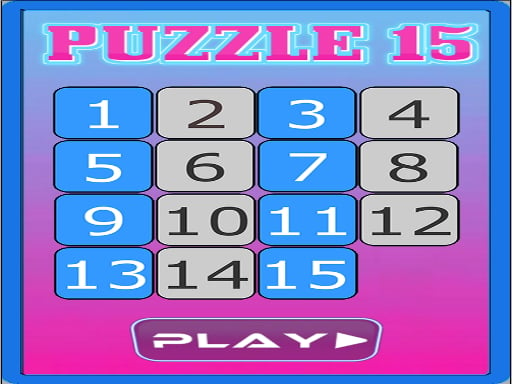
15 Puzzle is a classic single-player sliding game where your goal is to arrange a scrambled grid of numbered square tiles into sequential numerical order. Operating within a compact two-dimensional board, you shift individual tiles into an adjacent vacant spot one slide at a time. The game tracks both your active completion time and your total move count, inviting you to test your spatial reasoning, plan efficient movement sequences, and aim for faster clear times.
In 15 Puzzle, you are presented with a grid containing numbered tiles alongside a single empty opening. Only the tiles positioned directly adjacent to that open space can be shifted into it. The core gameplay loop revolves around evaluating the current layout, identifying where each number belongs, and strategically maneuvering pieces around one another to construct the proper sequence without trapping necessary numbers in awkward corners.
Because only adjacent tiles can move into the empty space, solving the board requires careful forward thinking rather than random sliding. As you shift tiles across the 2D surface, the on-screen interface continuously monitors both the elapsed seconds and the exact number of moves you execute. Whether you are solving the puzzle at a leisurely pace to exercise your logic or pushing for a swift finish, the visible timer and move tally provide instant feedback on every attempt.
Your goal
The primary objective is to rearrange all scrambled numbers into proper numerical order from start to finish. To achieve this, you must navigate pieces into position using only the open tile slot. Beyond simply solving the board, players can challenge themselves to streamline their movement paths, reduce wasted tile shifts, and complete the full ordering sequence under benchmark times such as the featured 1 minute 23.97 second record.
How to play 15 Puzzle
1. Look over the initial grid layout to spot the location of the empty space and the placement of the lowest numbers.
2. Identify which numbered tiles are directly adjacent to the open gap, as only these tiles are available to move.
3. Click or tap an adjacent tile to slide it directly into the vacant position.
4. Work systematically to assemble the early numbers into their correct sequential spots across the board.
5. Maneuver remaining tiles around the open slot until every number on the board sits in ascending order.
6. Review your final recorded move count and elapsed time displayed by the interface once the full sequence is complete.
Controls and device support
Use your mouse cursor on desktop or tap with your finger on touchscreen devices to slide adjacent tiles into the empty space.
- Controls: Mouse or touch
- Device support: Browser
- Game frame: 500 x 720
Rules to keep in mind
- Only tiles positioned directly next to the empty space can be shifted into that space.
- The puzzle is successfully solved when all numbers are arranged in complete numerical order.
- The in-game interface logs each movement input and counts elapsed time throughout your run.
What makes the challenge interesting
The defining mechanic of 15 Puzzle is constrained spatial mobility. Because there is only ever one unoccupied square on the board, every single move alters the routing possibilities for neighboring pieces. Solving the puzzle is not just about moving a target number toward its destination; it is about managing the empty space so that it arrives exactly where you need it without disturbing previously organized sections.
This creates an engaging balance between deliberate planning and kinetic speed. Players aiming for the lowest move count must visualize short multi-step cycles, while those hunting for rapid clear times must recognize standard movement patterns instinctively. Managing the board efficiently requires patience when establishing early rows and flexibility when rotating the final tricky corners into sequence.
Tips for 15 Puzzle
- Build the puzzle row by row or section by section from the lowest numbers upward. Trying to place arbitrary tiles at random often disrupts completed portions later in the run.
- Focus on maneuvering the empty gap rather than forcing a specific tile forward. Guiding the open space around obstacles lets you slide target numbers smoothly without undoing your structure.
- When placing the final numbers of a row, position the last two pieces together in a small rotation pocket to slide them into place as a synchronized pair without jamming the corner.
- Avoid rapid, impulsive clicking when a sequence stalls. Pausing to trace the open slot's route saves moves and prevents long strings of unnecessary correction slides.
Stages and progression
Because 15 Puzzle centers on a self-contained board challenge, progression comes through refining your solving technique and improving personal performance metrics over successive attempts. The game displays both the total number of moves and the elapsed timer, establishing a clear framework for self-paced improvement.
On early attempts, focus entirely on understanding tile rotation and completing the board consistently. As pattern recognition becomes second nature, you can set personal milestones to reduce total moves, eliminate hesitation pauses, and work toward testing your speed against target times like the 1 minute 23.97 second benchmark.
Playing on different devices
The game operates with a portrait-oriented 500 x 720 display canvas that functions cleanly across both desktop and mobile web browsers. Desktop players can click individual adjacent tiles with a mouse, offering deliberate cursor accuracy when planning intricate sequences.
Mobile users can interact directly via touchscreen taps with their fingers. The vertical layout fits handheld screens comfortably, making it convenient for quick single-handed puzzle sessions on the go.
The skills behind the game
Within the puzzle genre, sliding tile challenges hold a respected place as classic logic exercises that test spatial reasoning and sequential planning. Unlike riddles or word puzzles that depend on trivia knowledge, 2D number-ordering games rely purely on deterministic rules and visible information. Everything required to solve the grid is visible on screen from the opening move.
Single-player logic games of this format offer focused, contemplative play. They encourage players to experiment with rotational movements and learn how local shifts affect the broader arrangement, making each completed run a satisfying exercise in methodical problem-solving.
Who will enjoy this game
Players looking for a reliable 15 puzzle experience often seek straightforward brain teasers that launch instantly in a browser without complicated setups. A classic 15 puzzle game offers accessible mechanics that anyone can understand immediately, while retaining enough depth to challenge experienced speed-solvers.
For casual daily mental warm-ups, finding an engaging puzzle game online provides a quick way to exercise spatial logic and concentration. Tracking personal move efficiency and elapsed time allows solvers to practice at their own rhythm and set clear individual goals.
Frequently asked questions
How do you move tiles in 15 Puzzle? You can slide any tile that is located immediately next to the board's single empty space by clicking it with a mouse or tapping it with your finger.
What is the winning condition for 15 Puzzle? You complete the game by sorting all numbered tiles into numerical order across the grid until the full sequence is restored.
Does the game record performance stats during a puzzle attempt? Yes. The interface actively displays the total number of moves you have made along with the elapsed time taken to solve the board.
Something not right?
Tell us if the game does not load, the information is wrong or the content needs review.
Report a problem ›