 Hexa Candy Match 3
Puzzles
Hexa Candy Match 3
Puzzles
Play by tag
Free Online Hexagon Games
The hexagon tag brings together browser games structured entirely around six-sided geometry. While standard puzzle boards rely on four cardinal directions, hexagonal grids grant each cell up to six immediate neighbors. This structural difference fundamentally changes how tiles connect, how numbers merge, and how spatial paths form across the board.
7playable games



Tag guide
Six-Sided Spatial Puzzles on Hexagonal Grids
The hexagon tag brings together browser games structured entirely around six-sided geometry. While standard puzzle boards rely on four cardinal directions, hexagonal grids grant each cell up to six immediate neighbors. This structural difference fundamentally changes how tiles connect, how numbers merge, and how spatial paths form across the board.
Every title in this collection belongs to the puzzle category, but their gameplay spans distinct subgenres. Players will encounter mathematical merge games, fast-paced stack sorting under time pressure, cluster-rotation match-3 boards, and tactical turn-based grid exploration. Exploring this catalog means adapting your spatial reasoning to six-way movements and tighter board constraints.
How Hexagonal Layouts Change Traditional Puzzle Play
In a conventional grid, pieces interact primarily up, down, left, and right. Hexagonal layouts introduce angled diagonals that give every cell six adjacent contact points. This geometrical setup creates denser clusters and offers more avenues for combinations, but it also means blocked paths can choke a board much faster if placements are careless.
Whether you are dropping numerical tiles or picking spots to clear, the hexagonal framework requires checking multiple diagonal axes simultaneously. This extra layer of orientation makes familiar puzzle concepts feel distinct and mechanically fresh.
- Six points of contact per tile instead of the typical four
- Unique diagonal lines that create intricate chain reactions
- Tighter board boundaries where misplaced pieces quickly limit future moves
Number Merging on Six-Sided Boards
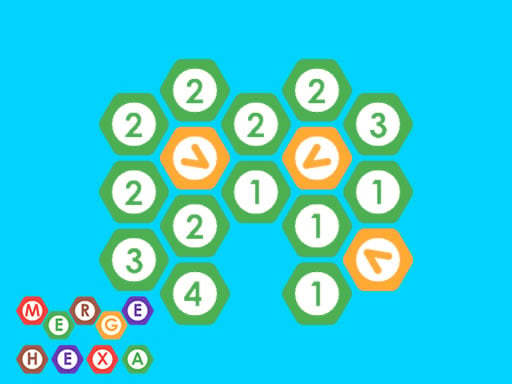
A prominent substyle within the collection focuses on arithmetic progression and tile combination. Games such as Merging Hexa challenge players to drag and drop numbered hexa pieces, combining matching values into progressively higher denominations to chase high scores.
Similarly, Hexa Merge 2048: Puzzle adapts the popular power-of-two formula to a colorful hexagonal environment. Players merge adjacent 2s, 4s, and 8s using simple taps. Because tiles can link along six distinct borders, planning combinations requires monitoring surrounding clusters to keep the central grid open.
Cluster Rotations and Three-Tile Sorting
Hexagonal geometry also revamps classic match mechanics. In Hexa Candy Match 3, the conventional swap mechanic is replaced by rotating clusters of candies around a central pivot to align color lines before a move counter expires. The angled layout turns line-clearing into a rotational spatial puzzle.
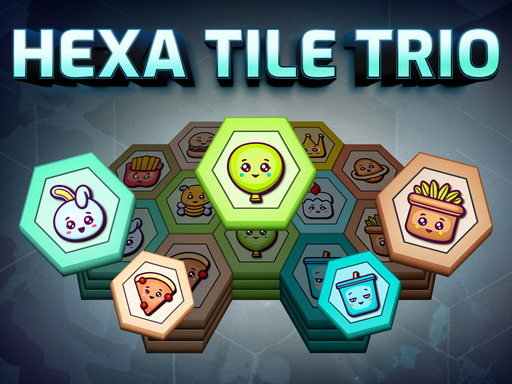
In contrast, Hexa Tile Trio introduces a sorting approach where players clear hex stacks by shifting tiles into groups of three within a designated holding zone. A ticking clock adds urgency, forcing quick visual identification of open slots before the board runs out of available space.
Tactical Exploration and 3D Tower Placement
Beyond matching and arithmetic, the hex grid serves as an arena for deduction and construction. TreasureBound shifts the setting to a turn-based treasure hunt across hexagonal ground tiles. Players must spend limited shovels carefully in solo Adventure levels or face off in a multi-round Duel mode against an opponent.
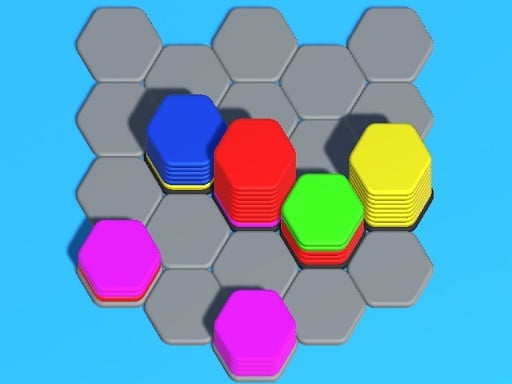
For a physical stacking dynamic, Hexa Sort 3D Puzzle uses drag-and-drop placement where each piece contributes to a growing tower structure. Players balance precision and pacing to stack pieces securely without misplacing structural hex elements.
How to Choose the Right Hexagon Game
Because the collection offers varied tempos and objectives, consider what kind of challenge you want before loading a game:
Check each title's individual on-screen instructions before starting, as some rely on simple tap-to-place actions while others require click-and-drag maneuvers or cluster rotation.
- Choose Merging Hexa or Hexa Merge 2048: Puzzle for relaxed, turn-by-turn arithmetic planning.
- Pick Hexa Tile Trio if you enjoy rapid visual scanning against a countdown timer.
- Select Hexa Candy Match 3 for thoughtful rotational puzzle solving under move limits.
- Launch TreasureBound for tactical digging, resource management, and head-to-head duels.
hexagon games FAQ
What makes hexagon puzzle games different from square grid games?
Hexagonal grids provide six neighboring connection points for each tile instead of four. This geometry allows for multi-angled chains, rotational cluster matching, and complex tile stacking that cannot occur on traditional square boards.
Are all games under the hexagon tag based on 2048-style merging?
No. While games like Merging Hexa and Hexa Merge 2048: Puzzle use arithmetic merging, other games in the tag feature rotational match-3 lines (Hexa Candy Match 3), timed 3-piece sorting (Hexa Tile Trio), tower stacking (Hexa Sort 3D Puzzle), and turn-based grid digging (TreasureBound).
What controls are needed to play these hexagon browser games?
Most titles in this collection use basic mouse clicks, touchscreen taps, or simple drag-and-slide gestures to place, rotate, or merge tiles. Exact input directions are provided on each game's title screen.
Can I play hexagon games in competitive or duel formats?
Yes, specific titles support competitive formats. For example, TreasureBound includes a Duel mode where two players alternate turns uncovering tiles, banking points, and using special powers across three rounds.