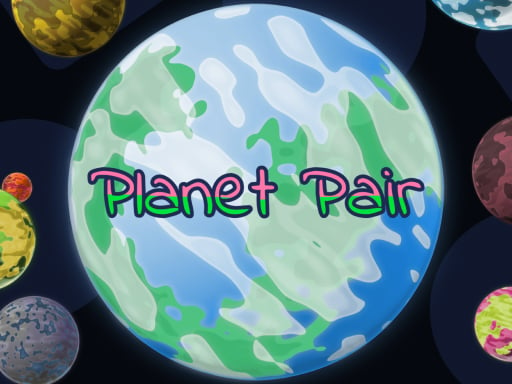
About Planet Pair
Planet Pair is a casual browser memory game where players uncover and match pairs of celestial bodies across structured rounds. Each attempt challenges your visual recall with expanding board sizes and randomized card placements. With a built-in timer running in the background, the primary focus is scanning the board efficiently, remembering planet locations, and clearing every phase in steady succession.
In Planet Pair, the core experience revolves around classic card-flipping memory mechanics set against an astronomical backdrop. Every full round consists of three separate phases designed to test your recall under progressively demanding conditions. You begin with a small layout and move to larger grids as each stage is completed.
Every phase randomizes the planet illustrations and their grid positions, preventing players from relying on memorized tile patterns across different runs. An active timer records the pacing of your session, giving you a clear benchmark to evaluate how quickly and accurately you can process visual information.
Your goal
The objective in Planet Pair is to locate and match all identical planet pairs across all three phases of a round as quickly as possible. Players aim to sharpen their observation, minimize wasted card flips, and improve their overall round completion speed against the clock.
How to play Planet Pair
1. Start a new round and view the face-down layout for the initial three-pair phase.
2. Point and left-click on a card with your mouse to reveal the planet hidden underneath.
3. Select a second card to find its matching planetary counterpart.
4. Clear all three pairs to advance to the six-pair second phase.
5. Uncover the randomized layout and match all six planet pairs to enter the final stage.
6. Solve the nine-pair grid in phase three to finish the round and check your completion time.
Controls and device support
Planet Pair uses standard mouse controls. Move your pointer across the grid and left-click on any face-down tile to select and flip it.
- Controls: Mouse or touch
- Device support: Browser
- Game frame: 1280 x 720
Rules to keep in mind
- Each full game round is split into three sequential phases of increasing grid size.
- Phase one contains 3 planet pairs, phase two contains 6 pairs, and phase three contains 9 pairs.
- Tile positions and planet assignments are randomized at the start of every phase.
- An active timer measures the total duration taken to solve the round.
What makes the challenge interesting
The primary skill in Planet Pair is spatial recall combined with visual categorization. Because many celestial illustrations share similar spherical silhouettes, rings, and color gradients, players must quickly distinguish distinct surface textures and hues. As the board grows from six tiles to eighteen tiles, maintaining an organized mental map becomes the deciding factor in maintaining speed.
Tips for Planet Pair
- Explore the board in structured rows or columns rather than clicking random spots. This systematic probing prevents you from repeatedly checking unknown tiles without a clear mental reference.
- Note distinguishing planetary features such as ring systems, surface craters, and bold color bands immediately upon revealing a card to avoid confusing similar-looking bodies.
- Pause briefly after uncovering an unmatched card to anchor its exact coordinates before flipping your next choice, reducing duplicate exploration.
- Prioritize pairs you already know before exploring fresh cards in the larger nine-pair phase, keeping your active mental list manageable under timed pressure.
Stages and progression
Progression in Planet Pair follows a structured three-phase escalation within each round. Phase one acts as a quick warm-up with just 3 pairs across 6 cards. Phase two doubles the complexity to 6 pairs across 12 cards, requiring stronger working memory. The concluding third phase presents 9 pairs across 18 cards, delivering the peak challenge of the run.
Because layouts reshuffle on every attempt, long-term mastery relies on refining your search habits and cutting down hesitation rather than memorizing fixed answers.
The skills behind the game
Memory and card-matching titles represent a foundational subgenre within web puzzle games. Planet Pair embodies this tradition by pairing accessible point-and-click mechanics with clear cognitive challenges. Players of all experience levels can easily pick up the rules, while the expanding board sizes provide an engaging workout for short-term spatial recall and visual pattern recognition.
Who will enjoy this game
Players looking for an enjoyable puzzle game online or a dedicated planet pair game will appreciate the structured pacing of Planet Pair. It serves as an excellent option for casual brain-training breaks, quick visual exercises, or timed memory challenges without unnecessary complexity.
Frequently asked questions
How many levels or phases are in each round of Planet Pair? Each round contains three phases. You start with three pairs, advance to six pairs in the second phase, and finish with nine pairs in the third phase.
Do the cards appear in the same spots in every game? No. The planet pairs and their board positions are randomized for every phase, ensuring a fresh layout and unique memory test on each attempt.
How do you control and select cards in Planet Pair? You play using your mouse. Move your cursor over any face-down tile and left-click to flip and inspect the planet beneath.
Something not right?
Tell us if the game does not load, the information is wrong or the content needs review.
Report a problem ›