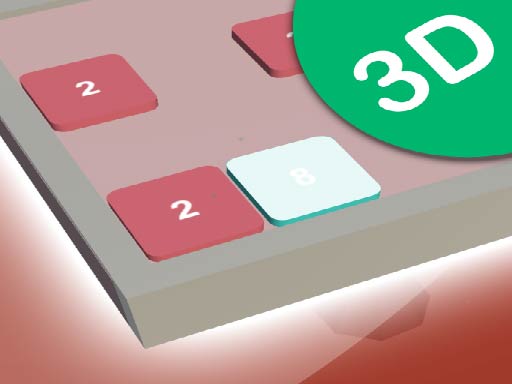
About Fly 2048
Fly 2048 blends the steady mathematical growth of numerical tile puzzles with the rapid tap-to-ascend flight of classic arcade obstacle games. Instead of sliding tiles across a quiet grid, players steer a flying numbered block through narrow openings between barriers. Every gate cleared increases your running score and doubles your active tile value toward 2048 and beyond, testing your aerial rhythm as the forward pace quickens.
Fly 2048 takes the iconic numerical progression of 2048 and places it directly inside an endless airborne obstacle course. You take command of a lone numbered tile starting at 2, floating forward into a continuous sequence of block barriers. Rather than merging identical numbers manually on a stationary board, progression happens dynamically in midair: each opening successfully navigated acts as a gate that upgrades your number into the next power of two.
Maintaining a steady altitude is the central challenge throughout every flight. Each jump or tap lifts your tile against constant downward drift, requiring measured inputs to squeeze through tight gaps without clipping the surrounding structures. As your score accumulates and your tile value climbs higher, the game's scrolling speed increases. This escalation forces you to anticipate openings faster and execute precision hops under growing pressure while aiming for a new personal best.
Your goal
Your objective is to navigate as far as possible by passing through barrier openings without colliding with any blocks. Every successful pass earns score points and transforms your tile into the next sequential power of two, starting at 2 and advancing toward 2048 and higher values. Because the scrolling speed ramps up alongside your score, long-term survival demands sharp reflexes, steady rhythm control, and beating your existing high-score benchmark.
How to play Fly 2048
1. Begin your flight with a base tile valued at 2 as it starts moving across the screen.
2. Observe the vertical placement of upcoming openings between the incoming block barriers.
3. Press any keyboard key, click the left mouse button, or tap your screen to flap upward and gain altitude.
4. Time your drops and ascents carefully to thread through the center of the narrow barrier gap.
5. Clear the gate to automatically raise your current score and double your tile value to the next power of two.
6. Adjust your reaction timing as the travel speed steadily quickens, flying as far as possible before colliding with a barrier.
Controls and device support
On desktop browsers, press any key on your keyboard or click the left mouse button to jump and gain altitude. On mobile or tablet devices, tap anywhere on the screen to flap upward and fly.
- Controls: Keyboard
- Device support: Desktop + mobile
- Game frame: 800 x 600
Rules to keep in mind
- Colliding with block barriers halts your run, ending your attempt to reach higher numbers.
- Passing cleanly through an opening awards score points and immediately upgrades your tile to the next power of two.
- Tile values begin at 2 and grow sequentially through 4, 8, 16, and on to 2048 and beyond with each consecutive clearance.
- The game increases its scrolling speed proportionally as your score increases, reducing the time available to adjust altitude.
What makes the challenge interesting
The signature tension in Fly 2048 comes from balancing aerial momentum against increasingly rapid barrier gates. Unlike a turn-based puzzle where every move can be calculated in advance, this game requires real-time physical rhythm. A single press provides an upward burst of height, after which gravity pulls your tile downward toward the lower obstacles.
Because the speed accelerates alongside your growing score, players must manage a delicate risk tradeoff between proactive elevation changes and reactive corrections. Tapping too early can cause you to overshoot into the upper block edge, while hesitating leaves insufficient room to recover from a downward plunge. Cultivating short, regular input intervals is critical to holding a level glide path right before entering each gate.
Tips for Fly 2048
- Aim to enter openings through the vertical midpoint of the gap. Floating too close to the upper or lower rim leaves zero margin of error if the tile drops unexpectedly.
- Favor gentle, rhythmic single taps over rapid button mashing. Spamming jump inputs creates violent upward spikes that frequently launch your tile directly into the ceiling blocks.
- Shift your visual focus one full barrier ahead of your current position. Anticipating the height of the subsequent gap gives your hands time to adjust before speed makes reactive flight impossible.
- Keep your altitude controlled during the transition between gates rather than coasting passively. Falling into a deep dip requires multiple recovery taps, which drastically increases the risk of overshooting.
Stages and progression
Difficulty in Fly 2048 scales continuously through velocity rather than discrete level transitions. The opening stretch allows players to settle into a comfortable jumping tempo while the tile value climbs through early powers like 4, 8, and 16. As your score accumulates, the forward travel rate quickens noticeably, demanding sharper reaction times and tighter flight lines to survive.
Because reaching the milestone tile of 2048 requires surviving dozens of consecutive gates at elevated speeds, long-term mastery revolves around personal pacing. A disciplined practice routine focuses on maintaining smooth, predictable jump arcs early on so muscle memory can manage the tighter reflex windows that appear in high-speed late-game runs.
Playing on different devices
Desktop players have versatile control options, with the game accepting either left mouse button clicks or any keyboard key press to flap upward. Using a broad keyboard key like the spacebar often provides a consistent tactile response for fine rhythmic adjustments. On mobile devices and tablets, simple full-screen tap inputs allow for quick, responsive jumps without needing to track a specific on-screen button.
The skills behind the game
While listed under puzzle games due to its iconic mathematical theme, Fly 2048 operates primarily as an arcade action challenge. Traditional number puzzles invite slow, deliberate planning across static grids, giving players all the time they need to calculate optimal tile merges. Here, mathematical progression is reimagined as an exciting visual milestone earned through aerial navigation.
The addition of balance and one-touch flying mechanics shifts the focus onto physical precision, hand-eye coordination, and timing discipline. By stripping away multi-directional board movement in favor of endless forward flight, the game provides immediate pick-up-and-play sessions that appeal to players who enjoy arcade survival games with clear numerical objectives.
Who will enjoy this game
Players searching for Fly 2048 or a new puzzle game online will find an unconventional cross-genre experience. Rather than offering another stationary grid clone, the game serves as quick reflex training for enthusiasts who enjoy fast obstacle courses paired with familiar numerical rewards. It is well suited for brief casual breaks between tasks where you want to test reaction speeds and aerial rhythm without managing complex rules.
Games with a similar feel
2048: In classic 2048, players slide numbered tiles along a four-by-four grid, carefully merging equal values to keep the board clear. Fly 2048 borrows the exciting powers-of-two growth progression but replaces spatial puzzle logic with real-time flight navigation. Players who prefer thoughtful, unhurried math strategies will favor the original, while those seeking adrenaline and reflex-driven arcade dodging will enjoy the flying format.
Frequently asked questions
How do tiles increase in value during the game? Your tile value doubles automatically each time you pass cleanly through an opening in the block barriers. Starting at 2, it advances sequentially through powers of two toward 2048 and higher as your score increases.
What happens when you hit an obstacle? Crashing into any part of the block barrier halts your flight, ending your current attempt and setting your final score and highest tile number achieved for that run.
Does the game get faster as you play? Yes. As your score climbs higher, the game's scrolling speed increases, forcing you to read incoming openings more quickly and maintain tighter control over your altitude.
Which controls can you use on desktop computers? Desktop players can flap and gain altitude by pressing any key on their keyboard or by clicking the left mouse button.
Something not right?
Tell us if the game does not load, the information is wrong or the content needs review.
Report a problem ›