Official listing
Game description
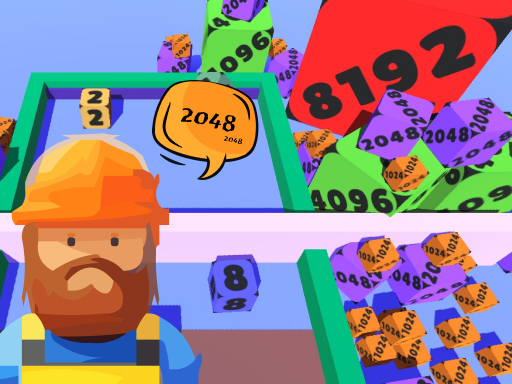
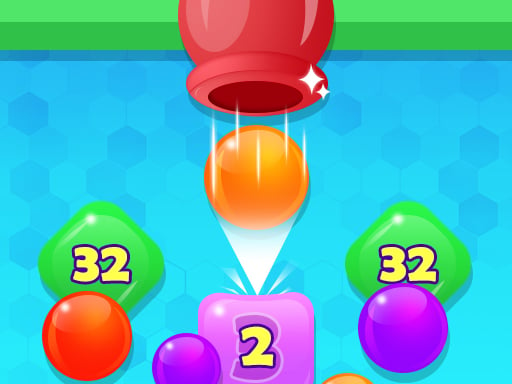
Endless 2048 game with a twist, blocks with physics. Blocks will colliide and bounce after collision. Drop and merge same numbers to reach higher numbers.
Puzzles game
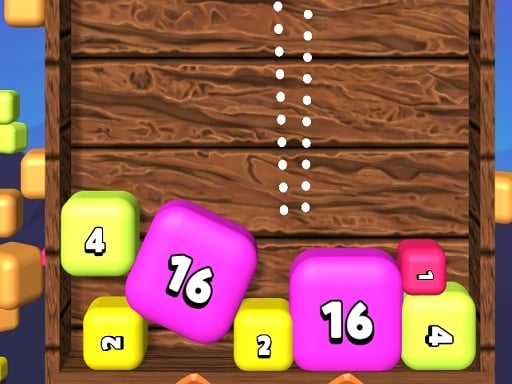
2048 Cubes combines arithmetic matching with dynamic physical interactions in an endless arcade layout. Instead of sliding tiles across a flat grid, you guide number-bearing blocks horizontally across the top of the board and release them into the play area. Blocks collide and bounce upon contact, making positional planning just as critical as numerical arithmetic. Your primary goal is to combine identical values to create larger numbers before the growing pile reaches the dashed line.

Choose Play now to load the game.
Official listing
Endless 2048 game with a twist, blocks with physics. Blocks will colliide and bounce after collision. Drop and merge same numbers to reach higher numbers.
From the game listing
Swipe right and left to move the block and release to drop Merge blocks with same number to get a bigger block Increase your score with more blocks Game ends when the board fills up to the dashed line
Open this card to load the gameplay video.
2048 Cubes combines arithmetic matching with dynamic physical interactions in an endless arcade layout. Instead of sliding tiles across a flat grid, you guide number-bearing blocks horizontally across the top of the board and release them into the play area. Blocks collide and bounce upon contact, making positional planning just as critical as numerical arithmetic. Your primary goal is to combine identical values to create larger numbers before the growing pile reaches the dashed line.
In 2048 Cubes, players navigate an active puzzle arena where spatial judgment directly influences every merge. Each turn delivers a numbered cube to deploy from above. By adjusting your alignment along the horizontal axis, you select where the block will fall into the pit below. When two cubes sharing the same number meet, they merge into a single cube displaying double the value, freeing up space and driving your running score upward.
Unlike traditional static tile puzzles, this title incorporates physical movement that alters the resting layout after every drop. Dropped cubes collide with existing blocks and bounce unpredictably across uneven surfaces, shifting neighboring pieces and opening or closing potential paths. Because the run continues indefinitely until blocks stack up to the dashed boundary, sustaining open space demands continuous observation of how angled impacts disrupt the board.
The core objective in 2048 Cubes is to continuously build higher-value blocks by merging matching numbers while preventing your stack from crossing the upper dashed boundary. Each successful fusion clears physical volume and raises your overall score. Success requires thoughtful placement to establish chain reactions, steady bank management to keep values accessible, and careful balance so that unexpected bounces do not prematurely crowd the top of the screen.
1. Observe the number displayed on the incoming block positioned at the top of the play screen.
2. Swipe or drag horizontally to align the active block over an open column or a matching number below.
3. Release your hold to drop the block straight into the puzzle pit.
4. Watch the block bounce and collide with existing cubes to contact identical values.
5. Combine matching values to trigger merges, generate higher numbers, and increase your score.
6. Monitor the top dashed line closely and keep dropping blocks to prolong your endless session.
Swipe or drag left and right to adjust the lateral position of the active block, then release your finger or mouse button to drop it into the arena.
The defining characteristic of 2048 Cubes is the interplay between mathematical sequencing and unpredictable physics. In traditional grid-based arithmetic puzzles, players rely on predictable coordinate shifts. Here, every cube retains momentum, deflecting off neighboring edges and settling in slightly uneven orientations. A player must weigh the temptation of dropping directly onto an identical cube against the danger of an oblique bounce knocking it into an unrelated lane.
This creates an engaging rhythm of deliberate calculation followed by dynamic visual feedback. Maintaining control requires building a stable base across the bottom row rather than creating tall, precarious spires. Players who carefully balance their columns create rolling channels where new blocks naturally slide toward their target partners, turning unpredictable collisions into advantageous cascading merges.
Because 2048 Cubes operates as an endless puzzle format, longevity rather than discrete level progression defines each attempt. As you continue to drop and merge blocks, the numerical values on the field gradually climb, creating denser arrangements that require greater spatial discipline.
A sound practice plan centers on session-over-session consistency. In early drops, focus on establishing clean horizontal baselines. As the board fills, shift attention toward reading angled surfaces to anticipate bounce trajectories, refining your release timing to keep the pile well below the dashed threshold.
On touchscreens and mobile devices, swiping left or right across the display offers an intuitive direct-drag method to align incoming cubes before lifting your finger to release. On desktop browsers, using a mouse to click and drag across the top gives precise horizontal placement, allowing players to fine-tune exact drop trajectories.
Number-combining puzzles represent an enduring branch of casual logic games, challenging players to evaluate spatial arrangements while performing quick mental math. While classic entries rely entirely on discrete turns and rigid coordinates, modern variations weave in simulated momentum and environmental gravity to invigorate routine calculations.
2048 Cubes fits squarely into this genre by blending numerical synthesis with physics simulation. Players who enjoy spatial planning find satisfaction in watching orderly numerical strategies survive the kinetic chaos of bouncing blocks, making it an engaging title for casual reasoning practice.
Players looking for a fresh merge puzzle game often seek experiences that require more than basic arithmetic. In 2048 Cubes, dropping blocks into an active arena requires players to anticipate physical deflections, making every match feel tactile and distinct from static tile games.
For casual gamers exploring a puzzle game online, the title serves as an accessible mental warm-up. Its simple swipe-and-release mechanic allows newcomers to jump in immediately, while the endless push to keep the stack beneath the dashed limit rewards steady focus and ongoing spatial practice.
2048: Like the classic 2048, 2048 Cubes revolves around merging identical numbers to build progressively larger values. However, while the original title employs a fixed four-by-four grid with four-directional sliding turns, 2048 Cubes introduces top-down drops and physical collisions where blocks bounce and roll. Players who prefer deterministic calculations will favor classic 2048, whereas those seeking real-time kinetic reactions will enjoy the active drops here.
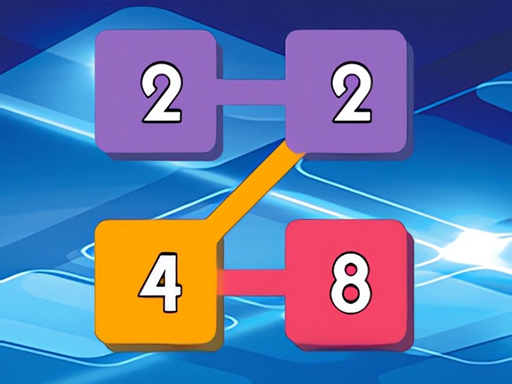
How do blocks merge in 2048 Cubes? Blocks merge whenever two cubes carrying the exact same number make contact. Upon colliding, they join together into a single block that displays double the original number, freeing up board space and boosting your score.
What causes a game over during a session? The game ends whenever the stack of cubes accumulates high enough to reach the dashed line near the top. Preventing blocks from piling up requires consistently combining matching numbers to keep vertical volume under control.
How does physics affect block placement? Instead of snapping rigidly to a static grid, blocks in 2048 Cubes carry weight and velocity. Dropped cubes collide and bounce off existing shapes, which can shift neighboring pieces or deflect your drop into adjacent spaces.
Tell us if the game does not load, the information is wrong or the content needs review.
Report a problemExplore popular games by category, shared tags and site-wide activity.