About Faraday Game Casual Physics
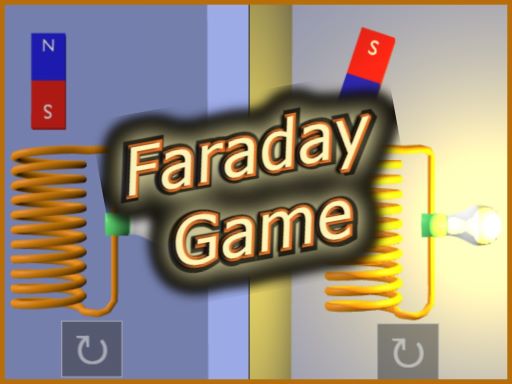
Faraday Game Casual Physics is an educational science simulation that turns electromagnetic principles into an interactive challenge. Inspired by Faraday's Law, the experience asks players to move or rotate a magnet near a conductive coil to change magnetic flux, produce electric current, and illuminate a lightbulb with maximum brightness.
Created by Prof. Dr. Rafael João Ribeiro, Faraday Game Casual Physics presents a visual 3D laboratory setup centered on electromagnetic induction. Players interact with a magnetic element positioned relative to a wire coil connected directly to a bulb. By displacing the magnet, you introduce changes in magnetic flux through the loop, which induces an electric current that drives the lighting apparatus.
The game provides two distinct operating modes to test your dexterity and understanding of induction geometry. In Angular mode, the objective is to rotate the magnet, whereas Linear mode involves vertical translation along the coil's axis. As you maintain continuous motion and increase the generated potential, the game evaluates your output against specific voltage milestones, offering language support in both English and Portuguese.
Your goal
Your main objective is to maximize the light intensity of the connected bulb by maintaining rapid, consistent magnetic flux variation. As your induction rate increases, you earn performance medals at 24 V, 60 V, and 110 V tiers while exploring how different movement patterns influence electric output.
How to play Faraday Game Casual Physics
1. Choose your preferred operational mode between Angular rotation and Linear vertical movement.
2. Select your language interface, choosing between English and Portuguese options.
3. Use one-button presses or screen taps to manipulate the magnet's position relative to the coil.
4. Maintain continuous movement to alter the magnetic flux across the coil windings.
5. Observe the lightbulb's brightness and aim for higher induction speed to earn the 24 V, 60 V, and 110 V medals.
Controls and device support
The simulation uses simple controls managed through single-button inputs or screen taps to drive magnet movement.
- Controls: Mouse or touch
- Device support: Desktop + mobile
- Game frame: 333 x 594
Rules to keep in mind
- Angular mode requires rotating the magnet to create flux variation through rotational displacement.
- Linear mode requires vertical movement of the magnet into and out of the coil field.
- Generating sufficient electrical potential awards scoring medals at 24 V, 60 V, and 110 V benchmarks.
- Performing multiple rapid touches or key presses unlocks an easter egg hack mode that enables higher voltage generation.
What makes the challenge interesting
The core appeal of Faraday Game Casual Physics lies in the direct tactile relationship between physical motion and electrical output. Rather than navigating abstract scoreboards, players focus on the rhythm and tempo of their inputs to create constant flux transitions. Fast, repeated movements generate stronger currents, visibly increasing bulb illumination in real time.
Mastering the mechanics requires balancing input consistency across both movement modes. In Linear mode, establishing a steady reciprocating pattern keeps the field lines shifting across the coil, whereas Angular mode rewards clean rotational cadence. This provides a direct, accessible demonstration of classical physics principles inside a focused hypercasual format.
Tips for Faraday Game Casual Physics
- Maintain a steady tapping rhythm rather than erratic bursts. Consistent input intervals help sustain peak magnetic flux variation and keep the bulb glowing brightly.
- Experiment with both Angular and Linear modes to discover which motion pattern offers you better control over sustained voltage accumulation.
- Avoid pausing mid-cycle, as decaying magnetic movement drops induced current quickly and lowers your chances of reaching the 110 V medal threshold.
- Try rapid multi-touch or multi-key input sequences if you want to discover the built-in easter egg hack mode for elevated voltage ratings.
Stages and progression
Progression is structured around voltage milestones that mark your mastery of electromagnetic induction. Players work their way from basic current generation toward specific medal tiers awarded at 24 V, 60 V, and 110 V. Achieving each higher tier reflects greater speed and consistency in altering the magnetic flux through the coil.
For players seeking additional challenge beyond standard medal ratings, the game includes a hidden hack mode activated by multiple concurrent inputs, opening higher voltage ceilings to test maximum tapping capacity.
Playing on different devices
The game operates in a vertical portrait orientation with a native canvas ratio of 333 by 594 pixels. This compact layout is well suited for single-hand mobile touch interactions as well as desktop mouse clicks or keyboard inputs.
Because the control scheme relies on one-button interactions or direct screen taps, both touchscreens and desktop peripherals provide quick, responsive magnet control during intense induction sessions.
The skills behind the game
As an educational hypercasual simulation, the game bridges simple arcade mechanics with real-world scientific demonstration. It transforms electromagnetic concepts that are often taught through static diagrams into a responsive, interactive loop where immediate visual feedback reinforces physical laws.
By relying on accessible one-touch controls and short, repeatable sessions, the title offers an approachable way for students, science enthusiasts, and casual players to experiment with induction dynamics without navigating complex simulation menus.
Who will enjoy this game
Players looking for faraday game casual physics experiences will find an engaging mix of rhythm-based tapping and educational physics modeling. The gameplay centers on the physical relationship between motion speed and induced voltage, making each attempt a test of sustained input pacing.
Whether you are practicing quick finger dexterity or exploring how rotational versus vertical magnetic movement affects coil current, this casual physics title delivers straightforward, goal-oriented practice sessions suitable for quick browser play.
Frequently asked questions
What is the primary scientific principle demonstrated in this game? The game models Faraday's Law of electromagnetic induction, demonstrating how moving or rotating a magnet changes magnetic flux inside a wire coil to produce electrical current and light a bulb.
What scoring tiers can players earn during play? Players earn voltage-based medals at three specific performance benchmarks: 24 V, 60 V, and 110 V, reflecting the intensity of the induced electrical potential.
What is the difference between Angular and Linear modes? Angular mode focuses on rotating the magnet around its pivot, while Linear mode requires moving the magnet along a vertical path relative to the induction coil.
How do you access the hidden hack mode? The game includes an easter egg hack mode that unlocks higher voltage potential when you input multiple screen touches or key presses simultaneously.
Something not right?
Tell us if the game does not load, the information is wrong or the content needs review.
Report a problem ›