About Draw That Line
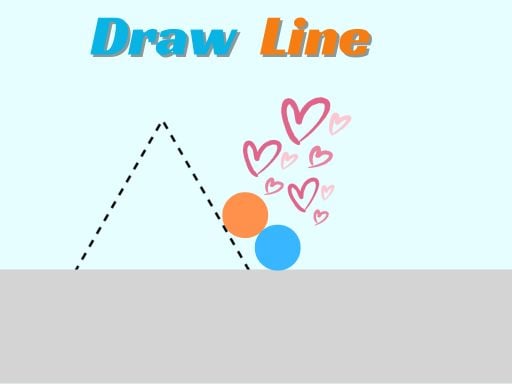
Draw That Line is a 2D drawing puzzle game where your primary objective is to use imagination and spatial reasoning to bump two balls together. By drawing freeform lines, curves, or solid geometric shapes directly onto the playing field, you create physical pathways, ramps, and weighted levers that guide the balls toward each other across various puzzle scenarios.
In Draw That Line, every stage presents an open canvas containing separated balls and scattered environmental obstacles. The core puzzle loop invites you to assess the starting positions of the balls and sketch custom strokes that interact with the game environment. Rather than controlling the balls directly, you influence their motion by creating structures such as angled slides, falling wedges, or protective barriers.
Once a stroke is drawn, it behaves as a physical object within the 2D space. The challenge revolves around predicting how your drawn lines will balance, roll, or slide to deliver sufficient momentum for the two balls to meet. Successfully connecting the balls completes the objective, encouraging players to experiment with both simple bridges and inventive kinetic contraptions.
Your goal
Your central goal is to bump the separated balls into one another by drawing effective lines or shapes on the screen. To solve each layout efficiently, aim to visualize the necessary slope or push before you start drawing, minimizing unnecessary strokes while ensuring the balls gain enough trajectory to make physical contact.
How to play Draw That Line
1. Examine the initial layout to locate both balls and note any gaps, platforms, or obstacles between them.
2. Press and hold the mouse button or touch the screen to begin drawing your intended stroke.
3. Sketch a ramp, funnel, or weighted shape designed to direct the movement of the balls.
4. Release your hold to solidify the drawing and watch how the physics interact with your creation.
5. Observe whether the balls successfully roll and collide, adjusting your drawing strategy if the contact is missed.
Controls and device support
Draw That Line supports both mouse and touch input. Hold down the left mouse button on desktop or press and drag your finger on mobile touchscreens to draw lines and shapes.
- Controls: Mouse or touch
- Device support: Desktop + mobile
- Game frame: 800 x 600
Rules to keep in mind
- The primary win condition is achieved when the two balls touch or bump into each other.
- Lines and shapes drawn by the player act as solid 2D physics objects to redirect or push the balls.
- Continuous input is registered while holding down the mouse button or touching the screen surface.
What makes the challenge interesting
The defining appeal of Draw That Line lies in creative problem-solving and spatial forecasting. Because you do not steer the balls with directional keys, success depends on understanding momentum, gravity, and structural balance. Every stroke you place can serve multiple functions: a tilted surface acts as a runway, a curved hook can catch a freefalling sphere, and a bulky block drawn high above can drop down to launch a resting ball forward.
This setup introduces a rewarding tradeoff between simple direct paths and complex kinetic levers. Drawing a direct ramp might seem straightforward, but if the slope is too steep or too shallow, the ball may stop short or overshoot its mark. Developing a steady drawing rhythm and visualizing how geometric shapes behave under gravity allows you to craft reliable, elegant solutions for tricky puzzles.
Tips for Draw That Line
- Create curved funnel shapes rather than straight lines when catching dropped balls to prevent them from bouncing erratically over the edges.
- Use heavy top-weighted shapes above a resting ball to act as a dropped hammer, giving stationary objects an immediate burst of forward momentum.
- Draw small anchor hooks around stationary platforms to keep long ramp structures from tipping over before the balls have finished rolling across them.
- Avoid drawing unnecessarily long or convoluted lines in a single stroke, as irregular geometry can snag rolling balls and halt their progress unexpectedly.
Stages and progression
As you tackle successive puzzle scenarios, the spatial relationships between the balls become increasingly intricate. While introductory setups may require simple connecting slopes, later puzzles introduce wider gaps, isolated ledges, and uneven terrain that demand more deliberate structural planning.
To improve your consistency across new layouts, practice breaking each problem into two stages: first create a safe landing or guiding chute for the moving ball, and then engineer the kinetic push needed to initiate travel toward the second ball.
Playing on different devices
Draw That Line is designed with a standard 800 x 600 display canvas that functions well across modern desktop browsers and mobile touch devices. On desktop setups, a responsive mouse offers sharp precision when sketching fine edges and delicate hooks.
When playing on touchscreens or tablets, using a stylus or a deliberate finger drag provides an intuitive, tactile drawing experience. Ensure your screen is clean to maintain continuous touch contact while sketching longer continuous shapes.
The skills behind the game
As a member of the physics puzzle category, Draw That Line emphasizes player agency through freeform construction rather than fixed-path movement. Physics drawing games stand out because they present open-ended logic problems with multiple valid solutions. Instead of selecting predefined puzzle pieces, players interact with a simulated environment where gravity, inertia, and mass dictate the outcome of every custom line.
The inclusion of 2D ball interactions pairs traditional mechanical puzzles with dynamic motion. This style of game appeals to players who enjoy testing hypotheses through quick trial, observation, and refinement, offering a relaxing yet mentally engaging sandbox for creative spatial thinking.
Who will enjoy this game
Players looking for a relaxing draw that line game often seek accessible brain teasers that test lateral thinking without demanding rapid reflexes. The format is well suited for casual sessions where you can experiment with varied physical contraptions at your own pace.
Engaging with a physics puzzle game online provides an excellent way to practice spatial visualization and mechanical reasoning. Whether sketching steep slopes or balanced pendulums, the open drawing mechanics encourage creative problem-solving suitable for puzzle fans of all skill levels.
Frequently asked questions
What is the main objective in Draw That Line? The main objective is to use your imagination and drawing ability to sketch lines or shapes that cause the two balls on screen to bump into each other.
How do you control your drawing tools in the game? You draw by holding down the left mouse button on a computer or pressing and dragging across the screen on mobile and touch-enabled devices.
Can I draw any shape I want to solve a stage? Yes, you can sketch open lines, enclosed shapes, or heavy structures, provided the resulting physical object successfully guides or knocks the balls together.
Something not right?
Tell us if the game does not load, the information is wrong or the content needs review.
Report a problem ›