About Connect The Satellite
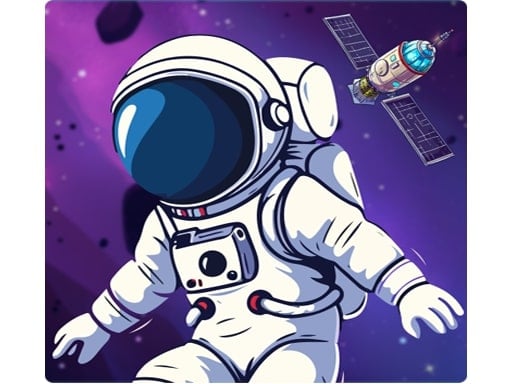
Connect The Satellite is a space-themed puzzle game where players create functional communication networks among orbital equipment and astronauts. Your task is to strategically draw paths across the board, linking every satellite to astronaut nodes so that all active components connect properly across increasingly difficult stages.
Set against the backdrop of outer space, Connect The Satellite challenges your spatial awareness and planning. Each stage presents a layout of dispersed satellites and astronauts waiting to be linked together. By planning out routes and establishing direct links, you turn scattered orbital assets into an organized network.
The primary gameplay loop focuses on evaluating the relative positions of all nodes on the screen before drawing lines between them. As stages progress, node placement requires more careful route planning to ensure that every satellite receives a valid connection without leaving any components isolated.
Your goal
Your objective is to connect all satellites with the astronauts on the board to form a complete network. Success requires ensuring that every single satellite links to at least one astronaut, solving the layout efficiently while keeping all network lines properly aligned.
How to play Connect The Satellite
1. Examine the layout of the current stage to identify the positions of all satellites and astronauts across the board.
2. Identify which astronauts are positioned closest to specific satellite clusters to plan clean connection paths.
3. Tap or click and drag from a satellite to an astronaut to establish an active link between them.
4. Continue drawing connections until every satellite on the field is linked to at least one astronaut.
5. Verify that all connections are aligned properly and complete the network to advance to the next level.
Controls and device support
Tap and drag on touch devices or click and drag with a mouse to draw connections between satellites and astronauts.
- Controls: Mouse or touch
- Device support: Desktop + mobile
- Game frame: 1920 x 1080
Rules to keep in mind
- All satellites must be connected to at least one astronaut to complete the stage requirements.
- Network connections must be drawn directly between the designated satellite and astronaut nodes.
What makes the challenge interesting
The core appeal of Connect The Satellite lies in spatial planning and network optimization. Rather than testing reflex speed, the game rewards players who pause to analyze the full screen before drawing lines. Each node configuration requires balancing direct routes with overall board clarity, encouraging thoughtful line management.
A key tradeoff involves deciding whether to connect multiple satellites to a single central astronaut or distribute connections across multiple astronauts. Evaluating node proximity helps prevent messy overlaps and ensures every satellite fulfills its mandatory link requirement.
Tips for Connect The Satellite
- Survey the entire screen before drawing your first line. Rushing into early connections can cut off convenient paths to isolated satellites later in the stage.
- Target outer satellites positioned along screen edges first. Securing peripheral links early prevents corner nodes from being overlooked when the central board becomes crowded.
- Distribute links evenly across available astronauts. Relying entirely on a single node can complicate path alignment across larger stage layouts.
- Check off every satellite systematically before finalizing your move. Forgetting a single satellite will prevent the network from reaching completion.
Stages and progression
Connect The Satellite features increasingly challenging levels that introduce more intricate node distributions across outer space. As you clear early layouts, later puzzles demand more thorough spatial planning and strategic line placement to connect every unit successfully.
To handle harder stages effectively, players can develop a methodical solving habit. Taking time to map out connection paths mentally before dragging ensures consistent progress as stage layouts become denser.
Playing on different devices
Designed with a widescreen 1920x1080 canvas, the game displays orbital nodes clearly on desktop monitors as well as high-resolution mobile screens. The drag interaction functions smoothly using either standard mouse controls on desktop or direct finger gestures on mobile touchscreens.
The skills behind the game
In the realm of browser puzzle games, network and connection puzzles provide satisfying logical challenges. These games center on linking dispersed elements according to clear structural rules, testing spatial visualization rather than timing pressures.
Connect The Satellite fits comfortably into this genre by combining clean visual elements with deliberate route planning. Players seeking engaging mental exercises can enjoy figuring out the optimal arrangement for each cosmic layout at their own pace.
Who will enjoy this game
Players looking for a relaxing puzzle game online will find Connect The Satellite an accessible and thoughtful choice. The simple drag mechanic makes it easy to jump into immediate network solving without complex setup.
Whether playing a quick session during a break or working through several consecutive stages, the game provides a great format for casual logic practice and spatial problem solving.
Games with a similar feel
2048: While 2048 focuses on sliding and combining numerical values on a compact grid, Connect The Satellite emphasizes spatial network linking across open space. Both games challenge forward planning, but Connect The Satellite suits players who prefer drawing visual connection lines between distinct targets rather than managing merging numbers.
Frequently asked questions
What is the primary goal in Connect The Satellite? The main objective is to connect all satellites on the board with the astronauts by drawing lines between them, completing the entire space communication network.
How do you control and draw connections in the game? You draw connections by tapping and dragging across touchscreens or clicking and dragging with your mouse between satellites and astronauts.
Can a satellite remain unconnected during a level? No, the core rule requires every satellite on the board to be connected to at least one astronaut to successfully complete the network.
Does Connect The Satellite require quick reflexes? No, the game focuses on strategic thinking and puzzle solving. Success comes from analyzing node positions and planning out clean connection routes rather than fast reactions.
Something not right?
Tell us if the game does not load, the information is wrong or the content needs review.
Report a problem ›