About Staircase To Heaven
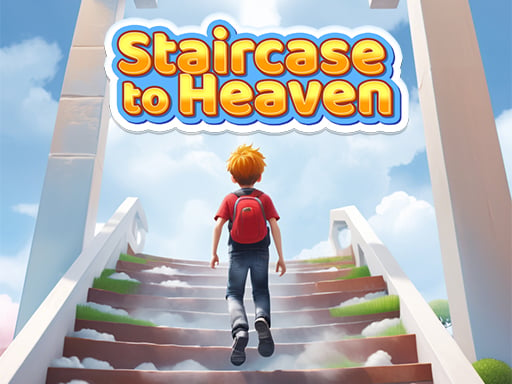
Staircase To Heaven is a third-person vertical climbing platformer where players embark on a high-stakes ascent from ground zero into the open sky. Inspired by vertical obstacle challenges, the game tasks you with navigating narrow footing and risky leaps where a single misstep can send you tumbling back down. Because the climb features no checkpoints, every jump demands full focus, disciplined movement control, and quick recovery reflexes whenever you lose balance.
In Staircase To Heaven, the entire world is structured as an upward journey. Starting from the very bottom, your runner must negotiate a towering succession of elevated pathways, floating structures, and discontinuous ledges. The primary loop consists of assessing upcoming footing, aligning your camera, building momentum, and timing jumps across open voids. Success requires maintaining steady forward progress while respecting the physical risks of each leap.
What elevates the tension is the complete absence of mid-course safety nets. Unlike conventional platformers that save your spot every few rooms, falling here means dropping directly down through the air. If you react swiftly during a descent, you might catch an intermediate beam or lower platform to salvage part of your height. If not, you face the prospect of dropping back to the starting floor, turning every higher section into an intense psychological test.
Your goal
The primary objective in Staircase To Heaven is to reach the summit by successfully ascending from ground level without suffering an irrecoverable fall. To achieve this, players must continuously balance speed against safety, refining their jump timing, learning how far sprinting carries their momentum, and staying calm under pressure so they can recover onto lower ledges whenever an unexpected slip occurs during the climb.
How to play Staircase To Heaven
1. Lock your mouse cursor using the designated toggle key so your view rotates cleanly around your character during movement.
2. Survey the immediate path ahead to identify stable platforms and notice gaps that require a running start.
3. Move forward using standard navigation keys, adjusting your speed between a steady walk and an accelerated run depending on footing width.
4. Press the jump key at platform edges to clear open spaces, adjusting mid-air trajectory toward safe landing zones.
5. React immediately if you stumble off a surface by steering your falling character toward any protruding lower structure to preserve elevation.
6. Continue your stepwise upward trek through increasingly complex vertical obstacles until you conquer the summit.
Controls and device support
According to the official instructions, control your character on desktop using W, A, S, and D to move forward and steer, hold Shift to run, press Space to jump, and press L to lock or unlock the mouse cursor for fluid camera aiming.
- Controls: See in-game controls
- Device support: Browser
- Game frame: 800 x 600
Rules to keep in mind
- No checkpoints exist along the climb; progress is preserved solely by staying aloft and landing safely on stable surfaces.
- Slipping off a ledge causes an immediate freefall, requiring you to steer mid-drop to land on lower structures or risk losing all altitude.
- Sprint and jump mechanics dictate your leap distance, meaning you must regulate your run momentum before leaping across varied gaps.
What makes the challenge interesting
The core appeal of Staircase To Heaven lies in high-stakes precision platforming and risk management. Because there are no checkpoints to cushion failure, every movement input carries genuine consequence. Players face a constant tradeoff between cautious, methodical stepping and aggressive sprinting to clear wide chasms. Moving too slowly prolongs tension and can cause short landings, while reckless sprinting invites fatal overshoots on narrow landing pads.
Developing spatial awareness and fast aerial correction is essential. When a miscalculated leap sends your avatar over the edge, panic leads to total altitude loss. Skilled climbers learn to maintain camera orientation during a fall, identifying intermediate girders, stairs, or roofs below to catch themselves and restart the ascent without returning all the way to ground zero.
Tips for Staircase To Heaven
- Toggle cursor locking with the L key before attempting difficult sections. Having smooth mouse-driven camera control ensures you judge platform angles and landing depth accurately.
- Reserve the Shift sprint modifier for broad leaps across wide chasms. Sprinting across tiny, narrow steps frequently results in uncontrollable overshoots and lost vertical progress.
- Keep your camera angled slightly downward when landing to verify your feet touch solid footing before you commit your next forward movement command.
- If you slip, fight the instinct to abandon control. Actively look down and steer toward broad lower structures to break your fall and preserve your altitude.
Stages and progression
Progress in Staircase To Heaven is measured directly by the altitude you gain above ground level. As you climb higher toward the skies, the path presents increasingly precarious architecture with fewer wide safety margins beneath your footing. Because the game does not feature structured checkpoints or automated save states, your practice journey involves learning each jump's timing through repeated attempts.
Rather than unlocking discrete upgrades or character enhancements, advancement depends entirely on player consistency. A disciplined climbing strategy involves mastering regular jump arcs on lower tiers before tackling the more stressful, high-altitude segments where recovering from a slip becomes significantly more difficult.
Playing on different devices
Staircase To Heaven is configured for desktop keyboard navigation within an 800 by 600 viewport. Using both hands—one dedicated to WASD movement and Shift/Space modifiers, and the other managing mouse direction with cursor locking—provides the precise spatial orientation needed for delicate aerial alignments.
The skills behind the game
As an adventure and action platformer, Staircase To Heaven strips away combat complexity to focus entirely on spatial navigation and environmental survival. While conventional adventure titles emphasize quest logs and item collection, vertical obstacle games challenge players to conquer physical terrain through disciplined execution.
The fusion of fast-paced running, precise jumping, and high vertical risk creates an exhilarating rhythm where patience and reaction speed matter equally. This dynamic appeals strongly to players who enjoy testing their spatial judgment across punishing obstacle courses.
Who will enjoy this game
Players searching for Staircase To Heaven or seeking a challenging adventure game online are usually looking for intense vertical obstacle trials that test composure and movement precision. The appeal lies in clear, unforgiving stakes where each successful jump represents earned progress.
Approaching the game as a casual climbing exercise lets you develop jump discipline over time. By focusing on steady pacing rather than rushing the ascent, runners can gradually build the muscle memory needed to reach higher tiers without succumbing to costly mistakes.
Games with a similar feel
Fall Guys: Fall Guys centers on navigating whimsical obstacle courses where stumbling over hazards leads to fun recovery races against other players. In contrast, Staircase To Heaven focuses entirely on a solitary, high-stakes vertical ascent where stumbling risks dropping you back to ground level due to the complete lack of checkpoints, making it ideal for players who want a punishing test of personal platforming endurance.
Frequently asked questions
Are there checkpoints in Staircase To Heaven? No. The climb contains zero checkpoints. If you fall and fail to catch yourself on a lower platform during descent, you can lose all accumulated progress and restart from the bottom.
How do you lock the camera cursor in the game? Press the L key on your keyboard to toggle cursor locking. This allows seamless third-person camera rotation with your mouse without the cursor leaving the gameplay window.
When should I use the sprint key? Use Shift to run when facing wide gaps that cannot be cleared with a standard walking jump. Avoid sprinting on small or narrow surfaces where momentum is hard to stop.
What should I do if my character slips off a ledge? Do not let go of the controls. Rotate your camera immediately to look downward, steer toward any visible lower platform, and try to break your fall to preserve height.
Something not right?
Tell us if the game does not load, the information is wrong or the content needs review.
Report a problem ›