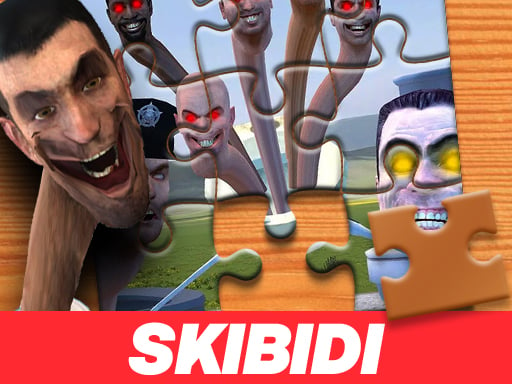
About Skibidi Jigsaw Puzzles
Skibidi Jigsaw Puzzles presents a browser-based tile assembly challenge centered on themed character artwork. Players manipulate loose, interlocking pieces across the screen to reconstruct a full image. By testing visual recognition and spatial awareness, the game offers a straightforward assembly experience suitable for casual puzzle enthusiasts looking for relaxing visual sorting.
In Skibidi Jigsaw Puzzles, the main task revolves around classic jigsaw puzzle mechanics set within a compact 800 by 600 display window. The playfield provides a collection of fragmented parts that must be sorted and repositioned to reveal the underlying artwork.
Each piece features unique interlocking tabs and blanks designed to fit into neighboring segments. The player surveys the disorganized board, identifies visual anchors like border edges or recognizable colors, and moves parts into place. The primary experience emphasizes steady observational sorting and tactile piece placement without frantic action.
Your goal
The objective is to assemble all interlocking puzzle pieces into their correct spots to form a complete, seamless picture. Success requires inspecting colors, outlines, and tab shapes, gradually connecting scattered parts until the final composition is fully restored.
How to play Skibidi Jigsaw Puzzles
1. Examine the layout of loose puzzle pieces scattered around the assembly area.
2. Select an individual piece and drag it toward your desired spot on the board.
3. Align interlocking tabs and blanks against complementary pieces to see if they fit.
4. Release or drop the piece into place once the matching segment is located.
5. Continue linking neighboring fragments together until the entire picture is fully assembled.
Controls and device support
The game instructions indicate that players drag and drop to arrange interlocking puzzle pieces across the screen.
- Controls: See in-game controls
- Device support: Browser
- Game frame: 800 x 600
Rules to keep in mind
- Puzzle pieces must be dragged and dropped into their intended arrangement across the board.
- Interlocking edges must align correctly with neighboring shapes to assemble the target image.
- The puzzle is complete only when all scattered fragments unite to form the finished picture.
What makes the challenge interesting
At its core, the game challenges visual deduction and pattern matching. Jigsaw solving relies on distinguishing subtle shifts in color gradients, identifying edge contours, and evaluating connector notches. Players frequently face the tradeoff between sorting loose pieces into outer borders first or assembling prominent internal focal points, such as central character faces.
Because the assembly space operates within an 800 by 600 canvas, keeping the work surface tidy is an important practical habit. Moving unrelated pieces toward the periphery allows you to focus clearly on active clusters without cluttering the center.
Tips for Skibidi Jigsaw Puzzles
- Separate straight-edge pieces from inner pieces early. Building the outer border first establishes clear spatial boundaries and prevents you from hunting through the entire pile for basic frame corners.
- Group fragments by distinct color patches or character outlines before connecting them. This systematic sorting reduces random dragging and keeps you from misplacing similarly shaped pieces.
- Examine connector notches closely alongside the printed art. When two pieces share matching background colors, their tab and blank shapes will reveal whether they truly belong together.
- Assemble recognizable picture elements in small islands away from the crowded center. Joining two or three verified pieces together makes them easier to slide into the primary frame later.
Stages and progression
While specific stage lists and difficulty configurations are not detailed in the game briefing, jigsaw puzzles naturally lend themselves to deliberate personal practice. Players can measure their own development by observing how quickly they identify border pieces or spot subtle line transitions across runs.
To build confidence, consider refining your initial sorting routine with each attempt. Focusing on methodical group organization before attempting final assembly creates a smoother, more efficient solving rhythm on subsequent tries.
Playing on different devices
The game renders in a fixed 800 by 600 pixel window. On desktop systems, a standard mouse offers precise control when clicking, dragging, and dropping small puzzle connectors into place.
On touch devices, players can use finger drag motions to manipulate pieces across the screen. Because smaller screens may condense the 800 by 600 playfield, careful fingertip placement helps avoid unintentional drops while repositioning tiles.
The skills behind the game
Jigsaw puzzle games represent a foundational corner of visual puzzle entertainment. Rather than testing quick reflexes or rapid inputs, they reward patience, spatial deduction, and keen attention to detail.
By combining popular online meme aesthetics with traditional tabletop assembly mechanics, games like this provide an accessible entry point for players who enjoy relaxing visual assembly challenges directly in a web browser.
Who will enjoy this game
Players looking for a skibidi jigsaw puzzles game often seek a lighthearted session that blends recognizable viral media with traditional puzzle-solving routines. Casual solvers frequently turn to a jigsaw puzzle online during short breaks to unwind without dealing with complex rule systems.
Engaging with an online puzzle game also serves as an enjoyable mental warmup. Sorting colors and shapes helps sharpen everyday observational skills, offering a satisfying sense of completion once the fragmented artwork clicks together.
Frequently asked questions
How do you move pieces in Skibidi Jigsaw Puzzles? You move pieces by using a drag-and-drop action. Select a piece with your mouse cursor or finger, slide it across the playfield, and release it in your target position.
What is the best way to start solving the puzzle? A dependable strategy is to hunt for flat-edged frame pieces first. Building the perimeter establishes the outer dimensions, making interior piece placement much easier to identify.
Can puzzle pieces be rotated? The available game instructions only specify dragging and dropping interlocking pieces to complete the picture; rotation mechanics are not documented in the official briefing.
Something not right?
Tell us if the game does not load, the information is wrong or the content needs review.
Report a problem ›