About Single Stroke Line Draw
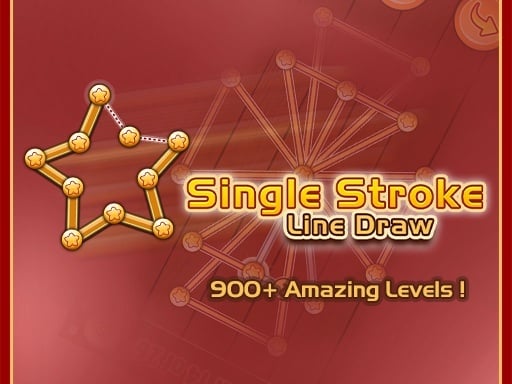
Single Stroke Line Draw is a focused logic puzzle where players connect a network of dots using one unbroken line. The primary challenge lies in traversing every required connection across the board without overlapping or repeating any route segment. Featuring straightforward rules and two distinct play formats—a relaxed Classic Mode and a brisk Timer Mode—the game tests spatial reasoning, forward planning, and topological awareness across progressively challenging arrangements.
At its core, Single Stroke Line Draw presents a clean grid of nodes linked by structural pathways. Your task in every stage is to guide a continuous stroke from point to point until all designated connections are fully linked. The central constraint requires completing the entire figure in a single movement, strictly forbidding you from retracing any line segment you have already drawn.
The game structures its puzzles around two separate experiences to suit different play styles. Classic Mode offers an unhurried environment ideal for deliberate thought, allowing players to analyze node configurations and trace potential routes mentally before making a commitment. In contrast, Timer Mode introduces direct time pressure, encouraging quick pattern recognition and decisive path selection. As you clear earlier stages, layouts expand in complexity, demanding sharper geometric intuition and careful navigation around branching intersections.
Your goal
The primary objective is to complete each level by drawing a continuous path that joins every dot without repeating any route. In Classic Mode, the goal centers on pure logic and clean puzzle resolution. In Timer Mode, players aim to identify viable paths quickly and execute each line efficiently before time elapses, balancing deliberate spatial planning with rapid execution.
How to play Single Stroke Line Draw
1. Select your preferred experience from the main menu, choosing Classic Mode for thoughtful puzzle solving or Timer Mode for a timed challenge.
2. Examine the board layout to identify all active dots and the network of routes connecting them.
3. Locate an advantageous starting dot, paying attention to intersections with an odd number of connecting lines.
4. Begin drawing from your chosen start node and continue moving smoothly from point to point.
5. Guide the line across every required connection without crossing over any path you have already traversed.
6. Connect the final dot to clear the puzzle and advance to the next level in the progression.
Controls and device support
Connect all the dots across the board in a continuous line to complete each level using mouse drag or touch inputs.
- Controls: See in-game controls
- Device support: Browser
- Game frame: 640 x 1136
Rules to keep in mind
- Every level requires drawing a single, unbroken stroke to connect the required network of dots.
- Route repetition is strictly disallowed; no individual line segment can be traversed more than once during a single attempt.
- All designated dots and connecting paths in the diagram must be completed to finish the stage.
- Players can select either Classic Mode for untimed problem solving or Timer Mode to solve puzzles under an active countdown.
What makes the challenge interesting
Single Stroke Line Draw is grounded in classical graph theory, specifically Eulerian path logic. Every puzzle asks whether a network of edges can be visited exactly once without lifting your pen or retracing your steps. Success relies less on speed and more on deductive foresight. Players must observe how lines branch from individual dots, anticipating dead ends before laying down a stroke.
The fundamental tradeoff in the game occurs between instinctual drawing and structured route analysis. Rushing into an intuitive line often leaves an isolated node stranded on the far side of the diagram with no legal way back. In Timer Mode, this balance becomes even more pronounced, as players must quickly evaluate vertex parity and commit to a complete path under tight temporal constraints.
Tips for Single Stroke Line Draw
- Count the connections touching each dot before drawing. Nodes linked to an odd number of lines generally must serve as your starting point or your final stopping point.
- Trace the entire route with your eyes before putting down your initial stroke. Visualizing the complete circuit prevents stranding outlying vertices halfway through the puzzle.
- Avoid drawing perimeter lines prematurely if doing so cuts off interior junctions. Maintain access to central intersections so your path retains flexible exit routes.
- Practice complex node patterns in Classic Mode before tackling Timer Mode. Building confidence with common geometric shapes helps you react instantly during timed runs.
- If a chosen start node leads to an unavoidable dead end, switch immediately to a different candidate point rather than repeating the same failed sequence.
Stages and progression
Single Stroke Line Draw structures its progression on an escalating curve of geometric complexity. Early puzzles begin with straightforward polygon outlines and minimal interior pathways, allowing newcomers to master the fundamental single-line rule. As you advance through successive stages, diagrams introduce denser clusters of intersecting lines, intricate symmetric frameworks, and multi-layered node webs.
The dual-mode structure provides natural difficulty scaling. Players seeking gradual mastery can advance steadily through Classic Mode at their own pace, while those looking to test their reflexes and rapid puzzle-solving ability can tackle the progression through Timer Mode.
Playing on different devices
Rendered in a vertical 640 by 1136 resolution, Single Stroke Line Draw is tailored cleanly for portrait orientation. On mobile devices and tablets, the layout provides direct tactile engagement, making direct fingertip dragging across dots natural and responsive. On desktop browsers, the portrait frame centers comfortably, allowing players to navigate intricate paths with standard mouse-drag precision.
The skills behind the game
Within the broader realm of puzzle and casual logic titles, dot-connecting and one-line drawing games occupy a celebrated niche. They translate abstract mathematical concepts like Eulerian paths into approachable, tactile puzzles suitable for short sessions or deep logic practice. Rather than testing complex mechanics, these games distill the challenge down to spatial reasoning, pattern recognition, and careful sequential planning.
Single Stroke Line Draw emphasizes this pure logic tradition by pairing clear geometric challenges with immediate accessibility. The clean node-and-path format strips away unnecessary clutter, offering puzzle enthusiasts an engaging exercise in graph navigation and spatial problem solving.
Who will enjoy this game
Players searching for a satisfying puzzle game online often look for experiences that balance clean visual rules with deep mental engagement. Single Stroke Line Draw provides exactly that balance by challenging players to resolve intricate geometric networks in one continuous motion.
Whether you want a calm daily warm-up in Classic Mode or a fast-paced test of spatial intuition in Timer Mode, this single stroke line draw game offers accessible mechanics that players of all skill levels can pick up instantly in a browser.
Frequently asked questions
Can I cross over an existing line segment in Single Stroke Line Draw? No. The defining rule of the game is that you must connect all dots without repeating or retracing any route segment. Every line on the board can only be traversed once per attempt.
What is the main difference between Classic Mode and Timer Mode? Classic Mode allows you to solve puzzles at your own relaxed pace without time pressure. Timer Mode adds an active countdown, requiring you to identify paths and connect dots swiftly to clear the stage.
How do I choose the best starting dot for a complex puzzle? Look at how many line segments connect to each dot. If a puzzle contains nodes with an odd number of connecting lines, choosing one of those odd nodes as your starting point is essential for completing the path without getting stuck.
Something not right?
Tell us if the game does not load, the information is wrong or the content needs review.
Report a problem ›