About Rock Paper Scissors Fight
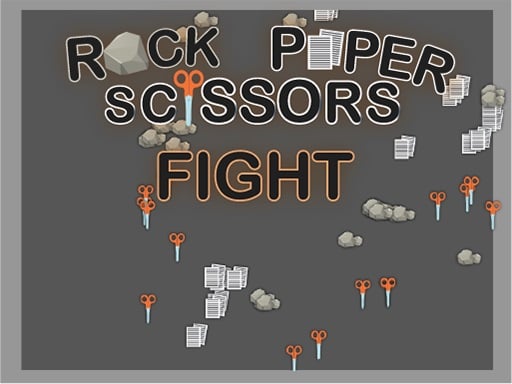
Rock Paper Scissors Fight transforms the classic schoolyard hand game into an active arena battle simulator. Instead of throwing a single hand sign against an opponent in turn-based rounds, players configure cohorts of rocks, papers, and scissors that roam freely across the field. By adjusting initial team counts and velocity settings, you orchestrate dynamic skirmishes where units collide under classic elimination rules until a single dominant group controls the entire board.
At its heart, Rock Paper Scissors Fight is an observational sandbox simulation inspired by the timeless triangular hierarchy of rock, paper, and scissors. Rather than demanding split-second reflex inputs or complex button combos, the title lets participants serve as scenario directors. Before launching a round, you establish how many rocks, papers, and scissors take the field and dictate how briskly they traverse the enclosed space.
Once launched, the entities scatter across the terrain like roaming beasts, careening in unpredictable trajectories until collisions occur. When opposing elements collide, the standard resolution rules decide the encounter, gradually thinning out vulnerable factions. Watching the chaotic ebb and flow provides a compelling look at emergent population dynamics, where an early advantage in one symbol can quickly trigger a cascade that shifts the entire balance of power.
Your goal
The primary objective in any round is to observe the autonomous clash until only one type of combatant remains on the board. Depending on your goals, you might try to engineer a perfectly balanced three-way stalemate that lasts as long as possible, or tilt unit quantities to see if an underdog faction can survive against overwhelming odds.
How to play Rock Paper Scissors Fight
1. Open the simulation setup screen to inspect the initial quantity sliders for rock, paper, and scissor units.
2. Decide the numbers for each faction, balancing them evenly for a fair contest or skewing numbers to create asymmetric scenarios.
3. Adjust the movement speed slider to determine whether entities roam slowly or sprint across the arena.
4. Start the simulation to release all active units onto the playing field.
5. Watch the units collide, track population swings, and wait until only one hand symbol survives to conclude the match.
Controls and device support
Interact with on-screen interface sliders and start buttons using your mouse or touchscreen to set unit quantities and movement speed before beginning the simulation.
- Controls: See in-game controls
- Device support: Browser
- Game frame: 750 x 1334
Rules to keep in mind
- The simulation continues autonomously until only one type of entity remains on the playing field.
- Players configure the starting numbers for rocks, papers, and scissors before the battle begins.
- Unit movement speed must be set prior to or during simulation setup to determine the pace of encounters.
What makes the challenge interesting
The core appeal of Rock Paper Scissors Fight lies in setting up initial parameters and observing complex emergent results. Because rocks defeat scissors, scissors defeat paper, and paper defeats rock, no single group holds an absolute advantage. If paper units dwindle quickly due to a swarm of scissors, the rock population suddenly finds itself without natural predators and can rapidly overrun the remaining scissors.
Pacing plays an essential role in how these skirmishes unfold. Slower movement speeds yield measured, easily tracked interactions where local pockets of advantage develop gradually. Conversely, dialing up the movement rate turns the arena into high-velocity bedlam, triggering rapid chain reactions that make match outcomes harder to forecast.
Tips for Rock Paper Scissors Fight
- Begin with equal counts of rocks, papers, and scissors to observe baseline interactions before testing uneven army sizes.
- Lower the movement speed if you want to study spatial grouping and understand why a particular group dominated the field.
- Avoid overcrowding the arena with maximum unit counts on your first run, as excessive density can trigger chaotic instant eliminations.
- Try creating an underdog challenge by drastically reducing one faction to see if its natural prey can inadvertently protect it.
Playing on different devices
Built with native dimensions of 750 by 1334 pixels, the game uses a vertical portrait aspect ratio that fits comfortably on modern mobile screens and narrow desktop browser windows.
On desktop monitors, running the game within an upright browser window preserves the intended viewing bounds, ensuring setup sliders and active units remain clearly visible across the entire field.
The skills behind the game
While cataloged under racing, the game primarily draws on battle simulator and running crowd mechanics. Instead of steering a vehicle along a track to reach a finish line, players manage crowd parameters and observe entities racing across open ground to engage rival groups.
This hybrid blend appeals to fans of casual ecosystem simulations and crowd physics experiments, where simple algorithmic rules produce intricate, unpredictable confrontations across a shared arena.
Who will enjoy this game
Players looking for a rock paper scissors fight game will find that this browser title shifts the traditional one-on-one hand gesture contest into a large-scale swarm conflict. Setting up custom clashes offers a relaxing, experimental pastime for anyone intrigued by probability, population balance, and autonomous battle simulations.
Although classified in feeds alongside racing game online options due to its swift entity movements, the experience is best approached as a dynamic tactical sandbox where you test varied starting scenarios to see which hand type ultimately survives.
Games with a similar feel
Street Fighter: Street Fighter emphasizes direct martial arts combat where two players master attack spacing, timing, and defensive execution. In contrast, Rock Paper Scissors Fight removes direct character execution, focusing instead on macro-level crowd simulation where players set initial population counts and observe autonomous skirmishes.
Mortal Kombat: Mortal Kombat centers on high-stakes one-on-one fighting matchups governed by precise martial arts inputs and timed reactions. Rock Paper Scissors Fight replaces close-quarters personal combat with a casual tactical simulation, letting players manipulate unit numbers and velocities rather than memorizing individual offensive moves.
Frequently asked questions
How do you win a match in Rock Paper Scissors Fight? Matches run until only a single faction remains active on the arena. Because the title functions as a simulator, players set the starting conditions and watch the outcome rather than directly steering an individual unit.
Can you change unit movement speed during the battle? Speed controls are established during setup to regulate the pace of the simulation, allowing you to choose between deliberate observation and rapid, frantic clashes.
Why does an outnumbered symbol sometimes win the entire match? The triangular counter rule creates indirect protection. If one faction eliminates the primary predator of an outnumbered group, that small group can suddenly multiply or clear out remaining targets unopposed.
Something not right?
Tell us if the game does not load, the information is wrong or the content needs review.
Report a problem ›