About Relative Velocity Casual Physics
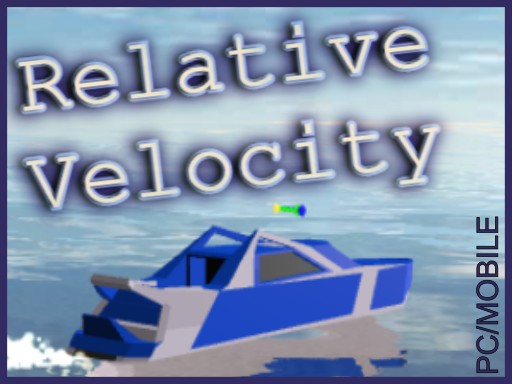
Relative Velocity Casual Physics challenges players to steer a boat across water shaped by shifting waves and water currents. By directing your boat's velocity vector with an on-screen joystick, you must balance forward momentum against natural aquatic forces to collect coins and cross the finish line as swiftly as possible.
Set in a bright three-dimensional aquatic environment, this title puts practical science concepts into motion. Instead of moving in a direct straight line, your vessel constantly contends with simulated waves and drifting currents that alter your true heading. The core loop revolves around actively compensating for these forces, steering along marked paths to pick up scattered coins, and docking safely at the destination marker.
Each stage tests both spatial anticipation and speed. Because your final score evaluates total elapsed time alongside every coin gathered, runs encourage thoughtful route planning rather than reckless throttle. Managing the vector angle allows you to glide smoothly around bends without drifting off course.
Your goal
Your objective is to guide the boat along the course to the finish line while gathering as many coins as possible. Maximize your stage score by minimizing completion time and avoiding unnecessary drift caused by conflicting water currents.
How to play Relative Velocity Casual Physics
1. Examine the water surface and course path to spot current directions and coin placements.
2. Engage the on-screen joystick to direct the boat's relative velocity vector.
3. Angle your vector against opposing waves to maintain steady progress along the marked path.
4. Maneuver directly through floating coins to add them to your stage tally.
5. Cross the finish line quickly to register your final time and score.
Controls and device support
Operate the on-screen joystick by clicking and dragging on desktop or touching and sliding on mobile screens to set the boat's relative velocity vector.
- Controls: See in-game controls
- Device support: Browser
- Game frame: 333 x 594
Rules to keep in mind
- Course Completion: The level concludes once the boat reaches the designated finish line.
- Scoring Determinants: Final points are calculated from the total number of coins collected and the overall completion time.
- Hydrodynamic Drift: The boat's actual trajectory combines user vector input with environmental wave and current forces.
- Increasing Challenge: Each progressive stage introduces tougher navigational conditions to overcome.
What makes the challenge interesting
The core dynamic centers on vector addition and predictive steering. In typical arcade driving, pointing a steering wheel immediately alters trajectory. Here, the boat's true course represents the resultant vector between applied thrust and the moving water medium. Mastering the steering rhythm requires players to aim slightly into crosscurrents to travel straight toward targets.
This creates a constant trade-off between aggressive speed runs and disciplined coin collection. Deviating wide to grab distant coins can expose the hull to strong opposing waves, potentially slowing down finish times and hurting overall score efficiency.
Tips for Relative Velocity Casual Physics
- Anticipate lateral drift by steering slightly upstream from coins. Aiming directly at a target in strong currents often causes you to sweep past it, wasting valuable seconds turning around.
- Maintain smooth, continuous adjustments on the virtual joystick. Sudden erratic swings can disrupt your momentum and make recovering alignment against choppy waves much harder.
- Balance coin collection against elapsed time. If a coin detour requires fighting a severe headwind current, consider whether the time lost outweighs the item's score value.
- Align your heading early for the finish straightaway. Setting a stable vector before the final stretch ensures you cross the line without last-second overcorrections.
Stages and progression
As you advance through consecutive levels, the navigation challenge scales steadily upward. Early courses introduce basic drift patterns, allowing players to build an intuitive feel for how velocity inputs merge with moving water.
Later stages intensify the environmental resistance, demanding sharper steering angles and tighter course management to maintain competitive completion times while securing coin objectives.
Playing on different devices
Designed in a vertical portrait orientation with touch-compatible controls, the interface functions naturally on smartphones and tablets using direct thumb manipulation on the virtual joystick.
On desktop web browsers, the same on-screen controller responds smoothly to mouse click-and-drag interactions, providing accurate vector positioning throughout each stage.
The skills behind the game
Although listed under casual sports and simulation categories, the gameplay bridges navigation puzzles with physics-based mechanics. Instead of relying purely on high-speed reflex maneuvers, players must observe hydrodynamic currents and calculate practical trajectories. This hybrid approach appeals both to players looking for relaxed boating simulations and those who enjoy applying real-world science fundamentals to solve spatial challenges.
Who will enjoy this game
Players exploring relative velocity casual physics look for straightforward browser games that turn core kinematics into interactive puzzles. Relative velocity casual physics game designs let enthusiasts practice vector compensation across fluid environments without requiring complex simulator flight sticks or racing wheels. Quick sessions provide an engaging way to test navigational reflexes against shifting aquatic barriers.
Frequently asked questions
How does relative velocity affect boat steering? Your boat's actual movement over the water is the combined result of your steered velocity vector and the pushing force of natural waves and currents.
What factors determine the final level score? Your score depends on the total count of coins collected along the route and how quickly you reach the finish line.
How do you control the boat on desktop and mobile? Use the virtual on-screen joystick by clicking and dragging with a mouse or sliding your finger on touch screens.
Something not right?
Tell us if the game does not load, the information is wrong or the content needs review.
Report a problem ›