About Reef Color Challenge
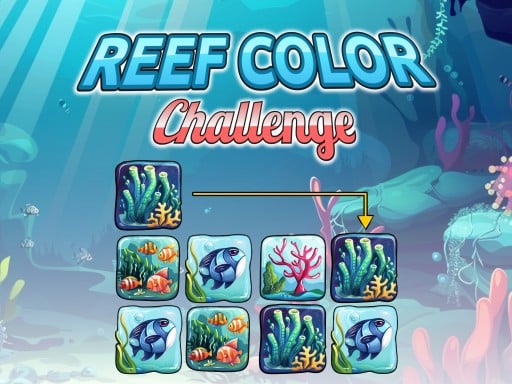
Reef Color Challenge is a fast-paced underwater logic game where quick reflexes and color recognition guide every move. Players navigate a single active block horizontally across columns positioned above a colorful stack. Each turn presents a shifting block color that must be aligned with identical hues below. As rows clear and lower blocks rise up, you must manage your positioning against the clock to keep the board under control.
Set in a vibrant underwater environment, Reef Color Challenge combines column navigation with immediate pattern matching. You control a solitary top tile that shifts between different colors from turn to turn. Beneath your active piece rests a layered stack of colored blocks waiting to be cleared.
The core gameplay loop centers on scanning the board, shifting your tile into the matching column, and making contact with identical colors. Lining up matching colors removes the target row, causing lower blocks to push upward and reveal new configurations. Because you are racing against the clock to clear as many rows as possible, every split-second decision directly influences how stable your stack remains.
Your goal
The main objective in Reef Color Challenge is to clear as many block rows as possible before time runs out. Players strive to maintain high accuracy and speed by identifying matching colors beneath the active tile, preventing the rising stack from overwhelming the screen while maximizing cleared lines.
How to play Reef Color Challenge
1. Observe the current color of your active block positioned at the top of the playfield.
2. Scan the top layer of the bottom stack to locate a column showing the matching color.
3. Touch or click the corresponding column to shift your active tile into alignment.
4. Watch the aligned row clear as underlying blocks rise up to form a new row pattern.
5. Adapt immediately to your tile's newly assigned color and repeat the process against the clock.
Controls and device support
Touch or click in the columns to move your active tile horizontally and line up matching colors with the stack below.
- Controls: Mouse or touch
- Device support: Desktop + mobile
- Game frame: 720 x 1280
Rules to keep in mind
- Your active block navigates horizontally across the top of the grid above the main block stack.
- The color of your active block can change with each turn.
- Matching your active block with a block of the same color below causes that row to disappear.
- When a row clears, the remaining blocks below push upward into the play area.
- Gameplay operates under a timed clock, challenging players to clear maximum rows during the run.
What makes the challenge interesting
Reef Color Challenge highlights visual speed and agile spatial sorting. The central tension emerges between swift movement and accurate color alignment. Because your active block can change its color on each turn, you cannot rely on repetitive motor patterns; every drop demands an instantaneous visual scan across all available columns.
The upward rise of lower blocks introduces dynamic board management. Rushing to tap a column without confirming the matching hue can disrupt your flow, while hesitating too long consumes valuable time on the clock. Balancing deliberate column selection with decisive input is essential for keeping pace as new rows continually emerge.
Tips for Reef Color Challenge
- Check your tile color before looking at the columns to avoid second-guessing where to aim under time pressure.
- Scan the entire top edge of the stack simultaneously so you can quickly spot alternative matching columns if several exist.
- Maintain a steady tapping rhythm rather than frantically rushing, which helps prevent misclicks on adjacent columns.
- Prepare your eyes for the upward movement of lower blocks so you can identify your next target the moment a row disappears.
Stages and progression
As you clear rows in Reef Color Challenge, the underlying stack continuously pushes upward to present fresh block arrangements. The challenge evolves through the ongoing race against the clock, encouraging players to refine their scanning speed and column targeting across consecutive attempts.
Players aiming to improve their performance can focus on establishing a dependable visual routine. Tracking how cleanly you identify color shifts and how quickly you reposition the active block offers a clear personal benchmark for each playthrough.
Playing on different devices
Reef Color Challenge is structured with a vertical 720 x 1280 resolution, making it naturally suited for portrait mobile screens and upright desktop browser windows. Direct screen taps allow immediate column selection on touch displays, while mouse clicks provide precise navigation on desktop setups.
The skills behind the game
As a casual logic puzzle, Reef Color Challenge emphasizes quick color sorting and hand-eye coordination over long-term strategic planning. Its column-based matching format delivers rapid micro-challenges that appeal to players who enjoy immediate visual puzzles and reflex-driven browser gaming.
Who will enjoy this game
Players searching for an engaging puzzle game online will find Reef Color Challenge accessible for short practice sessions or casual gaming breaks. The straightforward requirement to align matching blocks against a running clock provides an intuitive challenge for anyone looking to test their reaction speed and visual focus.
Frequently asked questions
How do you control the moving tile in Reef Color Challenge? You guide the active tile horizontally by tapping or clicking directly on the column where you want it to move, aligning it with matching colors below.
What happens when you align matching colors? Aligning your active block with a block of the same color clears that row. The remaining blocks underneath then rise up to form a new layout.
Does the active block stay the same color throughout the game? No, your active block can change its color on each turn, requiring you to re-evaluate the stack and find a matching column every round.
Something not right?
Tell us if the game does not load, the information is wrong or the content needs review.
Report a problem ›