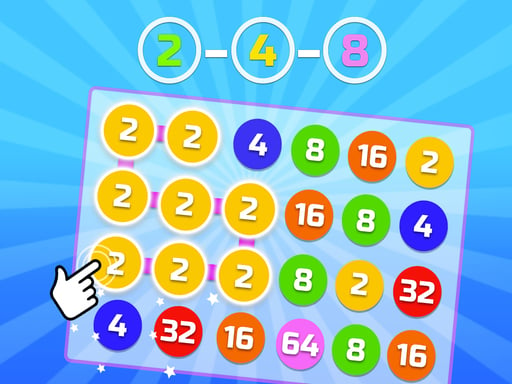
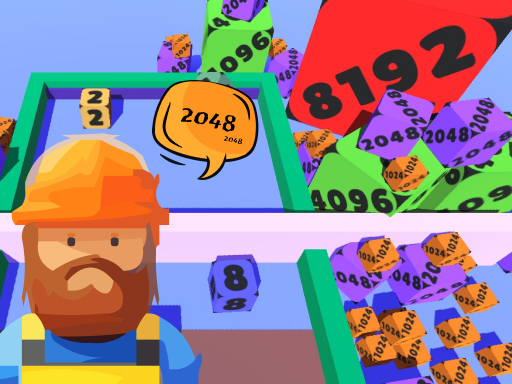
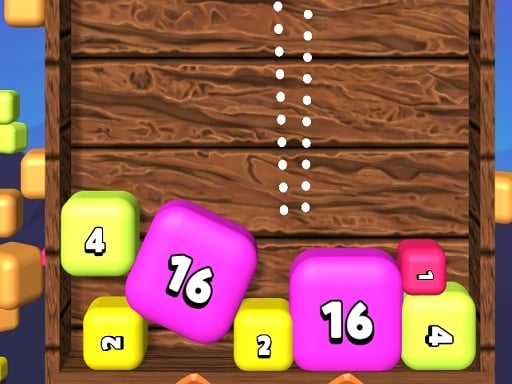
About Number Slide
Number Slide is a 2D logic puzzle where players untangle a scrambled grid of numbered squares. By sliding tiles one position at a time into open gaps, you must organize the board into a clean numerical sequence. The challenge asks players to test their spatial reasoning and problem-solving skills across both ascending and descending sorting tasks.
Number Slide presents players with a clean two-dimensional board filled with randomly arranged number tiles. Each puzzle begins in a jumbled state, requiring careful spatial coordination to navigate each numbered square across the board without permanently disrupting neighboring pieces.
The core gameplay loop centers on sequential ordering. Depending on the challenge presented by the game, your goal is to slide the numbers until the full collection rests in either ascending or descending order. Because movement relies on shifting adjacent tiles into vacant slots, every action requires thoughtful planning to avoid trapping crucial digits in opposing corners.
Your goal
The objective in Number Slide is to take a randomly arranged grid of number tiles and rearrange them into a completely ordered numerical sequence. Depending on the active challenge, you must slide tiles into empty spaces until the board is uniformly arranged in either ascending or descending numerical sequence.
How to play Number Slide
1. Examine the scrambled 2D grid to locate which tiles are out of position and identify the empty space on the board.
2. Check the round conditions to determine whether the tiles must be arranged in ascending or descending sequence.
3. Tap a tile adjacent to the open gap to slide it into that vacant space.
4. Shift tiles systematically along rows and columns to guide key numbers toward their intended positions.
5. Complete the sequence across the entire grid to finish the puzzle challenge.
Controls and device support
The game uses tap inputs to move tiles. On mobile devices, tap any tile bordering an empty slot to slide it; on desktop browsers, click the tile with your primary mouse button to achieve the same movement.
- Controls: Mouse or touch
- Device support: Desktop + mobile
- Game frame: 800 x 600
Rules to keep in mind
- Number tiles begin in a randomly arranged layout across the grid at the start of a puzzle.
- Tiles move by sliding into adjacent open spaces across the 2D playing surface.
- The puzzle is solved only when all numbers form a perfect sequence, either ascending or descending as required by the challenge.
What makes the challenge interesting
The primary skill in Number Slide is spatial foresight. Unlike simple match puzzles, sliding tile games require moving pieces through constrained pathways where each shift temporarily disturbs neighboring spaces. Players cannot place a tile directly where they want it without navigating around existing blocks.
This creates an engaging cognitive tradeoff between short-term convenience and long-term board structure. Moving a tile into its target spot too early can lock off access routes needed for subsequent numbers. Developing a steady rhythm of solving rows or borders first keeps the remaining board flexible and prevents frustrating gridlock.
Tips for Number Slide
- Anchor the first row or column before moving later numbers. Establishing an organized boundary gives you a stable baseline and avoids shuffling previously placed pieces back into open play.
- Always verify whether the round demands ascending or descending order before moving tiles. Solving toward the wrong end forces you to undo finished rows and reconfigure the entire board.
- Plan shifts two steps ahead rather than tapping on reflex. Aimless sliding often drives high and low numbers into opposing dead ends, making late-stage rotations much harder.
- Keep your empty space mobile near the active section of the board. Letting the vacant slot get isolated behind completed tiles restricts your maneuvering options.
Stages and progression
Number Slide alternates the nature of its challenge by requiring either ascending or descending number arrangements. Moving from low-to-high ordering to high-to-low ordering forces players to invert their mental mapping of the grid, keeping familiar spatial layouts fresh and demanding adaptability.
Because specific level counts and unlock conditions are not strictly predetermined, players can measure their own progression through efficiency and planning. Striving to solve boards with cleaner movement paths and fewer wasted slides builds stronger spatial intuition across successive puzzle attempts.
Playing on different devices
The game operates within a native 800 x 600 display resolution, providing a compact 2D canvas that fits comfortably inside standard web browsers. On mobile screens, the designated tap control makes moving adjacent tiles simple and responsive directly under your fingers.
On desktop monitors, the same tap instruction translates directly to standard mouse clicks. The 800 x 600 fixed aspect ratio ensures that all tiles and numbers remain clearly visible without demanding high graphical overhead or complex hardware.
The skills behind the game
Number Slide falls within the hypercasual and 2D number puzzle category. These games focus on immediate, clean logic challenges that require minimal onboarding while encouraging deliberate mental problem-solving.
By stripping away complex narrative mechanics, 2D number puzzles emphasize pure pattern recognition and sequence planning. Players who enjoy accessible brain teasers can engage in short, focused sessions that test spatial thinking without unnecessary friction.
Who will enjoy this game
Players looking for a classic number slide experience typically seek straightforward mechanics centered on tactile grid manipulation. The appeal of a number slide game lies in turning a disordered cluster of figures into a coherent, neat sequence through methodical steps.
Engaging regularly with number sorting puzzles offers casual mental exercise that sharpens sequential reasoning. Whether sorting upwards or downwards, working through these sliding board exercises provides an accessible logic break during everyday downtime.
Frequently asked questions
What is the main goal in Number Slide? The main goal is to rearrange a randomly scrambled grid of number tiles until they form a complete sequence, arranged either in ascending or descending order depending on the round.
How do you control and slide tiles in this game? You interact with the board by tapping on a tile next to an empty spot. On desktop setups, clicking with your mouse performs the exact same sliding action.
Are all puzzle boards solved in the same numerical direction? No. The game presents different challenges where you must order numbers either in ascending sequence from lowest to highest or descending sequence from highest to lowest.
What is the best strategy for solving a number slide game? Focus on solving one row or boundary at a time rather than shifting pieces randomly. Setting up the corners and edges first preserves open room in the remaining grid for easier tile rotation.
Something not right?
Tell us if the game does not load, the information is wrong or the content needs review.
Report a problem ›