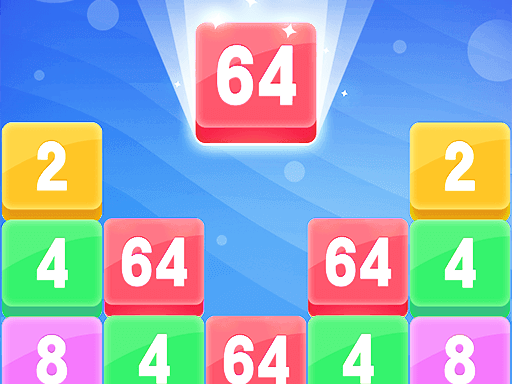
About Merge Brick
Merge Brick is a browser-based puzzle challenge focused on spatial management and smart positioning. Players drag and combine blocks of matching types to consolidate them into a single piece, clearing valuable room on the board. Success depends on calculating each move carefully to maximize available space, maintain a tidy layout, and build toward higher scores as stage difficulty scales upward.
In Merge Brick, your main task is to organize an evolving board by combining pieces of the same type. Whenever identical blocks come together, they merge into a single consolidated unit. Because every placement alters the open layout, finding optimal positions before you drop or slide a piece is critical to keeping the playfield open.
The core loop revolves around continuous spatial planning, clearing space through timely combinations, and striving for a high score. Each level introduces a fresh challenge with rising difficulty, encouraging players to balance immediate mergers against long-term board organization. With straightforward mouse interactions and clear visual cues, the game delivers quick, thoughtful sessions that reward deliberate strategy.
Your goal
The primary objective in Merge Brick is to achieve the highest possible score by consistently merging matching blocks into single units while maintaining enough open space on the board. Players work through successive levels of increasing difficulty, aiming to solve each layout through efficient placement and forward-looking organization.
How to play Merge Brick
1. Inspect the active board layout and note where identical blocks are currently situated.
2. Use your mouse to grab and drag a block toward an advantageous spot on the grid.
3. Combine blocks of the same type so they merge together into a single block.
4. Assess the remaining open tiles and calculate your next drop to prevent overcrowding.
5. Continue merging pieces efficiently to complete level challenges and build higher scores.
Controls and device support
The game is played using the mouse to drag, position, and merge blocks across the board.
- Controls: Mouse or touch
- Device support: Browser
- Game frame: 1920 x 1080
Rules to keep in mind
- Combining blocks of the same type merges them into a single consolidated block.
- Players interact by dragging blocks into target positions across the play area.
- Each level presents an independent challenge with increasing overall difficulty.
- Successful placements and merges contribute directly toward higher point totals.
What makes the challenge interesting
Merge Brick centers on spatial foresight and geometric management. The defining skill is anticipating how a single merge affects adjacent open slots. When two identical pieces unite, they free up room, but placing an intermediate piece in the wrong lane can isolate matching blocks and quickly clutter the play area.
The key strategic tradeoff lies between taking quick, convenient merges and engineering deliberate setups for greater space conservation later. Players who rush immediate combinations may accidentally block upcoming moves, whereas calculating optimal positions keeps the board flexible as level demands grow steeper.
Tips for Merge Brick
- Scan the entire board before dragging any piece. Identifying matching pairs early helps you clear lanes efficiently and prevents accidentally stranding useful blocks in tight corners.
- Keep central spaces as clear as possible. Crowding the middle of the grid limits your maneuvering options and makes it harder to connect matching tiles on opposite sides.
- Group similar block types into dedicated zones. Keeping identical pieces relatively close reduces the number of intermediate moves needed to combine them into single blocks.
- Prioritize moves that open multiple adjacent tiles simultaneously. Maximizing free space gives you the necessary breathing room to manage higher difficulty levels smoothly.
Stages and progression
Merge Brick structures its progression through sequential levels, where each stage introduces a fresh puzzle setup with heightened difficulty. As you advance, managing board space requires deeper logical thinking and more disciplined position calculation.
To handle later stages effectively, players should refine their placement habits during early levels. Focusing on clean board maintenance and deliberate merging paths will help you stay composed when denser layouts and tighter configurations appear.
Playing on different devices
Merge Brick runs in standard desktop web browsers and uses primary mouse inputs to select, drag, and drop blocks into place. The game canvas is formatted for a 1920 x 1080 widescreen presentation, providing a broad visual overview of the entire grid.
A stable mouse grip and smooth cursor tracking ensure precise placements, preventing accidental drops onto incorrect grid tiles during tight board situations.
The skills behind the game
Merge Brick fits squarely into the casual logic and block puzzle tradition. Unlike fast-paced reaction games, block-combining puzzles emphasize deliberative spatial planning and pattern recognition. Players are invited to assess the current board state, evaluate how individual moves affect overall grid capacity, and find tidy solutions to spatial bottlenecks.
Because sessions are structured around self-contained levels, the game offers approachable mental exercise for casual breaks while still presenting substantive strategic depth for dedicated puzzle fans.
Who will enjoy this game
Players looking for an engaging merge puzzle game online often seek clean mechanics that reward logical thinking without unnecessary complexity. Merge Brick satisfies that interest by providing an accessible block-merging system where success comes from careful placement and space management.
Whether you are practicing grid organization or enjoying a quick daily logic workout, the Merge Brick game delivers a straightforward, satisfying blend of strategy and casual puzzle progression.
Frequently asked questions
What is the primary goal in Merge Brick? The main goal is to combine blocks of the same type into single units, clearing board space and scoring points while solving increasingly difficult level challenges.
How do controls work in Merge Brick? You control the game using your mouse to drag individual blocks and position them next to matching tiles on the grid.
How do you achieve higher scores in the game? You earn higher scores by consistently calculating optimal placements, merging matching blocks, and maintaining sufficient open board space throughout each level.
Does Merge Brick feature different stages? Yes, the game is divided into levels that offer new challenges with increasing difficulty, requiring greater logical thinking and strategic planning as you advance.
Something not right?
Tell us if the game does not load, the information is wrong or the content needs review.
Report a problem ›