About Happy Filled Glass 4
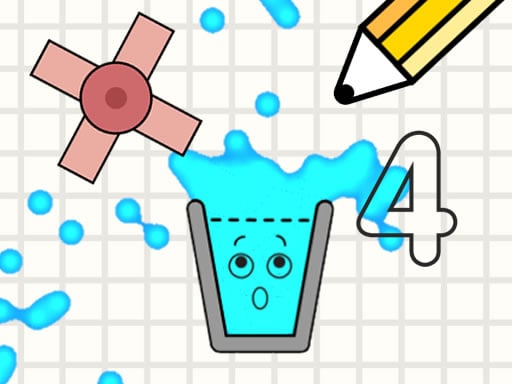
Happy Filled Glass 4 is a physics-based puzzle challenge where you draw pencil lines to guide moving water safely into an empty glass. Success requires planning an optimal route across layouts filled with complex mechanical obstacles, such as rotating barriers, burning surfaces, magnetic elements, and directional zones. Every stage tests your understanding of movement, gravity, and trajectory.
In Happy Filled Glass 4, players interact with a physics environment centered on fluid movement. The primary objective on each screen is to route a stream of water into a waiting glass by sketching pencil barriers, ramps, and funnels directly onto the play area. Because liquid behaves dynamically, the angle, curvature, and placement of your drawn strokes directly dictate whether the stream splashes away or flows neatly into the target vessel.
The puzzles steadily introduce diverse interactive obstacles that alter water behavior. You must account for burning platforms that threaten the flow, speed-boosting surfaces that accelerate droplets, rotating platforms that disrupt steady streams, magnets that influence movement, and special up-and-down areas that shift elevation. Solving each puzzle involves observing these hazards, sketching a viable conduit, and adjusting your geometry until enough liquid settles into the container.
Your goal
The core objective in Happy Filled Glass 4 is to draw the optimal path that channels released water safely into the glass until it is sufficiently filled. To achieve this, you must analyze the spatial relationship between the liquid dispenser, the obstacles in between, and the resting position of the cup. Mastering each setup means minimizing liquid loss and steering clear of destructive environmental hazards.
How to play Happy Filled Glass 4
1. Examine the layout to locate the water source, the destination glass, and any hazards positioned across the playfield.
2. Identify specific obstacles along the path, including burning platforms, rotating barriers, magnetic pulls, and accelerating ramps.
3. Use your mouse or touchscreen to draw a continuous pencil line designed to guide and catch the descending water stream.
4. Watch the water release and observe how droplets bounce, roll, or accelerate across your drawn structure and the stage elements.
5. Refine your line angle, funnel width, or shield placement if water spills outside the glass or collides with destructive obstacles.
Controls and device support
The official instructions specify mouse click or tap to play. On desktop systems, hold the left mouse button and drag across the screen to sketch pencil lines. On mobile or touch devices, press and slide your finger across the display to draw paths.
- Controls: Mouse or touch
- Device support: Desktop + mobile
- Game frame: 1080 x 1920
Rules to keep in mind
- A stage requires channeling water into the glass to fill it up successfully.
- Pencil drawings act as solid guidance paths that redirect the flow of water droplets across the screen.
- Water must navigate around or across interactive elements, including burning platforms, rotating platforms, and speed boosters.
- Environmental features such as magnets and special up-and-down areas physically alter water trajectory during transit.
What makes the challenge interesting
Happy Filled Glass 4 focuses on physical problem-solving, structural foresight, and fluid mechanics. Unlike rigid grid puzzles, drawing puzzles present open-ended solutions where slight variations in slope or curvature dramatically alter liquid behavior. A shallow line might allow droplets to pool or overflow, while an overly steep incline can launch water past the rim of the glass.
The key skill lies in balancing redirection with momentum control. Players must anticipate how water behaves when striking accelerating strips or drifting through magnetic fields. Constructing lines that both shield liquid from burning platforms and funnel momentum downward requires thoughtful experimentation and a keen eye for angles.
Tips for Happy Filled Glass 4
- Curve your line upward at the receiving end of the glass to form a gentle funnel, preventing fast-moving droplets from bouncing off the rim.
- Build protective overhead deflectors above burning platforms so falling water flows over an insulated barrier rather than touching dangerous heat.
- Account for kinetic boosts from water-accelerating platforms by sketching extended containment ramps that catch high-velocity streams safely.
- Keep drawn slopes steady and continuous, avoiding jagged notches or abrupt breaks where individual water droplets might snag and spill.
- Observe rotating platform cycles before drawing your route, aiming your conduits through gaps where moving blades will not swat the water away.
Stages and progression
Progression in Happy Filled Glass 4 unfolds across individual puzzle layouts that gradually integrate layered mechanical obstacles. Early challenges typically focus on straightforward downhill slopes and simple containment curves, allowing you to get comfortable with liquid momentum and pencil drawing responsiveness.
As you advance, puzzles combine multiple interactive mechanisms on a single screen. You may need to guide water through upward force zones, swing it past rotating obstacles, and counteract magnetic pulls before reaching the glass. Approaching progression methodically by testing small structural adjustments on each attempt helps overcome complex multi-part physics boards.
Playing on different devices
Happy Filled Glass 4 operates at a portrait-oriented native resolution of 1080 x 1920, making it well-suited for smartphones and tablets held vertically. On mobile browsers, direct touchscreen swiping provides an intuitive, tactile feel for sketching pencil paths with a finger or stylus.
When playing on desktop monitors, the vertical display renders centered within the window. A standard mouse click-and-drag setup offers steady cursor stability, allowing players to draft deliberate, straight ramps and fine-tuned funnels without accidental screen obscuration.
The skills behind the game
Happy Filled Glass 4 fits naturally into the casual physics puzzle genre, where logical spatial planning meets real-time fluid simulation. Games of this style encourage experimentation, tasking players with transforming a blank screen into a functional hydraulic chute through creative drawing.
By incorporating dynamic elements like speed boosters and gravity-shifting zones alongside classic physical barriers, the game tests quick visual estimation and problem-solving skills without demanding complex control schemes or lengthy tutorials.
Who will enjoy this game
For players searching for an accessible happy filled glass 4 game experience, this title provides instant browser-based play with zero setup required. It appeals directly to fans seeking a casual puzzle game online that emphasizes creative physics deduction over reflex-heavy gameplay.
Whether you have five minutes to spare or want to tackle a series of structural challenges, playing Happy Filled Glass 4 offers engaging mental exercise in trajectory planning, slope calculation, and fluid containment across both mobile and desktop setups.
Frequently asked questions
What is the primary objective in Happy Filled Glass 4? The main goal is to sketch pencil lines that guide liquid past obstacles such as fires, spinners, and magnets to completely fill the waiting glass.
How do you control the pencil in Happy Filled Glass 4 game? You draw routes by clicking and dragging with a desktop mouse or tapping and swiping your finger across the touchscreen on mobile devices.
How do environmental obstacles affect the water flow? Obstacles alter fluid behavior: burning platforms threaten droplets, accelerating platforms launch water quickly, rotating arms disrupt flow, and magnets pull liquid off course.
What should you do if water splashes outside the glass? Redraw your guide line with a wider funnel, a gentler decline, or an extended lip near the glass opening to cushion incoming droplet momentum.
Something not right?
Tell us if the game does not load, the information is wrong or the content needs review.
Report a problem ›