About Guess the path
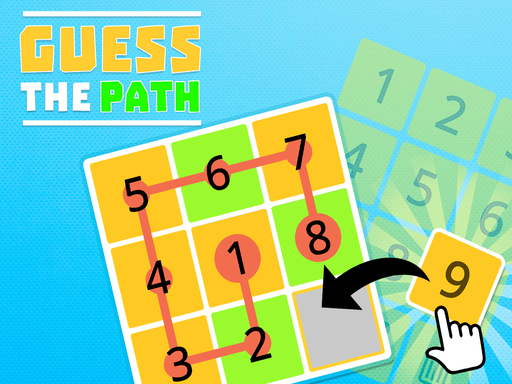
Guess the path is a logical brain puzzle where players must connect every square on the board by forming a continuous numerical sequence. Starting with accessible early stages and expanding to larger grids, the game challenges your spatial reasoning to link numbers from 1 to X across the entire layout without skipping any boxes.
Guess the path delivers a clean, focused board puzzle experience centered around number placement and pathfinding. Players are presented with a grid that must be completely filled using consecutive numbers from 1 up to the total box count. Each sequential number must sit adjacent to its predecessor, creating an unbroken chain across the board. While introductory stages offer a gentle start that feels quick and simple, subsequent levels expand the grid dimensions, significantly increasing the complexity of finding the single valid route. The game tests foresight and deductive reasoning as you ensure no tile is left isolated or unreachable.
Your goal
The primary objective in Guess the path is to completely fill the board with consecutive numbers from 1 to X. To solve each puzzle successfully, every single box must be connected into an unbroken sequence where each number sits directly adjacent to the number before it, leaving zero empty tiles when finished.
How to play Guess the path
1. Inspect the empty or partially numbered grid to identify the starting point labeled 1 and the target layout.
2. Place number 2 in an adjacent box next to number 1 on the grid.
3. Continue sequencing consecutive values so that each subsequent number is placed immediately next to the preceding box.
4. Route your sequential path carefully through corners and edges to ensure no empty boxes become trapped or skipped.
5. Reach the final number X, filling every available tile on the board to complete the level.
Controls and device support
- Controls: See in-game controls
- Device support: Browser
- Game frame: 600 x 800
Rules to keep in mind
- Sequential Placement: Numbers must increment sequentially from 1 to X, with each value positioned adjacent to the previous number.
- Full Grid Coverage: Every box on the puzzle board must be occupied by a number to complete the stage.
- Continuous Path: The numbers must form a contiguous path connecting all boxes without breaks or gaps across the grid.
What makes the challenge interesting
Gameplay in Guess the path revolves around spatial planning and deductive logic. Because every single box must be occupied in consecutive order from 1 to X, making a premature turn can isolate empty corners and create dead ends. Early levels allow for straightforward experimentation on smaller boards, but advanced stages require players to visualize multiple steps ahead before committing a path. Successfully navigating the grid involves analyzing available neighbor cells at each step, balancing immediate adjacencies with long-term coverage of the full grid layout.
Tips for Guess the path
- Plan your route around the outer perimeter early to avoid trapping isolated corner tiles that cannot be reached later.
- Look ahead several numbers before selecting a tile, ensuring your chosen neighbor leaves an open exit for the next step.
- Count remaining empty squares on larger grids to verify that your planned sequence has enough room to reach the final value X.
Stages and progression
Progression in Guess the path starts with simple, compact boards designed to introduce the basic sequencing mechanic. As players advance to higher levels, grid dimensions expand and require longer numerical paths, substantially elevating the difficulty and demanding deeper logical calculation.
The skills behind the game
As a member of the Puzzles category with board and logical brain tags, Guess the path appeals to enthusiasts of spatial reasoning and numerical challenges like Sudoku. It emphasizes deliberate deduction and spatial management over high-speed reflexes, fitting naturally into educational and hypercasual puzzle collections.
Who will enjoy this game
Players looking for an engaging puzzle game online will find Guess the path game an approachable yet demanding mental exercise. When searching for guess the path, logic enthusiasts discover a grid-based sequential challenge centered on clear rules, continuous paths, and steadily increasing board complexity.
Frequently asked questions
What is the main goal in Guess the path? The goal is to fill the entire grid with consecutive numbers from 1 to X, placing each number adjacent to the one before it until all boxes are connected.
Does Guess the path become harder as you play? Yes, while introductory levels are simple, difficulty increases significantly as grid dimensions expand, requiring players to solve larger, more intricate pathfinding layouts.
How must numbers be arranged on the board? Every number must follow the previous one consecutively on the grid, meaning number 2 sits next to number 1, number 3 sits next to number 2, and so on.
Something not right?
Tell us if the game does not load, the information is wrong or the content needs review.
Report a problem ›