About Fruit Club
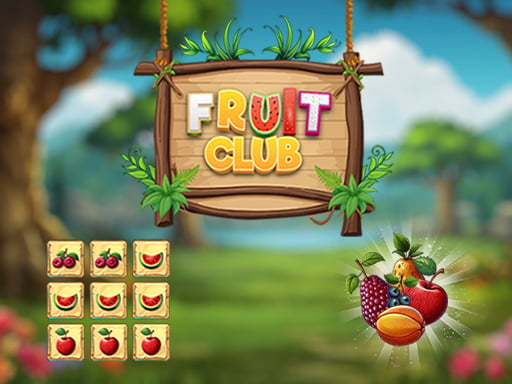
Fruit Club is a 2D casual puzzle game focused on thoughtful tile placement. Players inspect a board of fruit pieces and determine the exact location where each tile belongs. Precision and planning are vital from the very first move, as making an incorrect placement results in an immediate game over. The title offers an accessible brain-teaser format designed for quick analytical sessions on both desktop and mobile browsers.
Fruit Club presents a clear matching and spatial arrangement challenge built around colorful fruit tiles. Instead of relying on rapid reflexes or continuous falling blocks, the core gameplay loop asks players to examine the available pieces, evaluate valid board spots, and carefully position each item in its intended slot.
Success in the game requires deliberate decision-making. Placing a tile into its proper position moves the puzzle closer to completion, while placing a piece incorrectly brings the session to an abrupt end. The simple visual presentation keeps attention focused entirely on logical deduction, offering a clean, casual puzzle experience that fits neatly into short play sessions.
Your goal
The primary objective in Fruit Club is to solve the puzzle board by correctly placing every fruit tile in its designated position to win the game. Players must maintain steady focus and verify every placement beforehand, ensuring that no misplaced tile triggers a sudden game over.
How to play Fruit Club
1. Launch Fruit Club in your web browser and observe the layout of the fruit tiles.
2. Survey the board to identify distinctive fruit patterns, matching cues, and open positions.
3. Select a fruit tile using your mouse cursor or touchscreen input.
4. Position the chosen tile into its corresponding correct place on the board.
5. Continue placing remaining tiles accurately until the entire board is solved without making an erroneous move.
Controls and device support
Interact on PC using the left mouse click, or use direct on-screen touch taps when playing on Android and mobile devices.
- Controls: Mouse or touch
- Device support: Desktop + mobile
- Game frame: 720 x 1280
Rules to keep in mind
- Fruit tiles must be placed in their exact designated positions to solve the puzzle and achieve victory.
- Placing a tile in an incorrect location immediately results in a game over.
What makes the challenge interesting
The core appeal of Fruit Club lies in its strict placement criteria combined with relaxed input pacing. Because an incorrect placement instantly ends the run, the game rewards cautious observation over impulsive clicking. Players must mentally verify matches and alignment before committing each move.
This structure creates a distinct risk-versus-certainty rhythm. Rather than rushing through visual matches, the optimal approach involves scanning the entire layout to confirm obvious placements first. By eliminating certain slots methodically, you narrow down ambiguous positions and prevent costly misclicks.
Tips for Fruit Club
- Scan the entire layout before interacting with any piece. Rushing your initial placement can lead to an instant mistake before you understand the full board arrangement.
- Identify and place the most obvious matching fruit tiles first. Securing definite placements reduces visual clutter and makes remaining positions easier to deduce.
- Take your time before confirming each placement. Because any wrong placement triggers a game over, double-checking your destination spot protects your ongoing run.
- Maintain steady precision on touchscreens. A common mistake is accidental tapping near tile boundaries, so ensure your tap lands squarely on the intended target.
Playing on different devices
Fruit Club operates with a vertical 720 x 1280 resolution, making it well-suited for portrait viewing on mobile smartphones and tablets. On mobile devices running Android, players can navigate and position tiles using standard on-screen touch taps.
On desktop computers, the game is controlled entirely via left mouse clicks. The lightweight footprint ensures smooth performance across standard web browsers without demanding heavy hardware resources.
The skills behind the game
Within casual 2D matching and puzzle games, tile placement titles emphasize spatial deduction and pattern recognition over high-speed action. Players who enjoy relaxing mental exercises appreciate puzzles where every move requires deliberation rather than frantic inputs.
Fruit Club fits naturally into this genre by blending simple matching themes with clear failure parameters. Its straightforward visual structure offers an accessible entry point for casual puzzle fans looking for light brain training during breaks.
Who will enjoy this game
Players searching for an accessible puzzle game online often seek casual titles that can be played instantly without complex installations or extensive tutorials. Fruit Club answers this demand by delivering direct tile-matching mechanics accessible across multiple browsers.
For enthusiasts of match 3 puzzle games and logic challenges, the game offers a focused exercise in spatial arrangement. It serves as an easy-to-learn casual distraction suitable for practicing pattern identification at your own comfortable pace.
Games with a similar feel
Candy Crush Saga: Candy Crush Saga revolves around swapping adjacent pieces to clear match-three combinations across extensive level maps. In contrast, Fruit Club focuses on arranging individual fruit tiles into designated board locations with instant loss penalties for incorrect placement, offering a more direct spatial placement exercise.
Bejeweled: Bejeweled pioneered classic gem-swapping match-three gameplay centered around continuous board shifts and cascades. Fruit Club shares the colorful visual matching theme but differentiates itself by challenging players to solve fixed tile positions accurately rather than clearing lines on an active grid.
Frequently asked questions
What is the main goal in Fruit Club? The goal is to analyze the puzzle board and place each fruit tile into its correct position to solve the puzzle and win the game.
What happens if a tile is placed in the wrong spot? Placing a fruit tile in an incorrect position results in an immediate game over, requiring you to restart the puzzle challenge.
Can Fruit Club be played on mobile devices? Yes. Fruit Club supports on-screen touch controls on Android and mobile browsers alongside standard mouse controls for PC players.
Something not right?
Tell us if the game does not load, the information is wrong or the content needs review.
Report a problem ›