About Draw Game
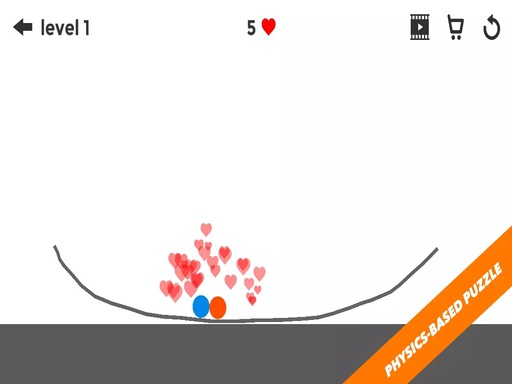
Draw Game is a physics-based puzzle experience where your main task is reuniting two separated dots across obstacle-filled playfields. By sketching custom lines, ramps, and solid geometric structures directly into the level, you create functional pathways that push, roll, or catch the two characters. Each stage presents a fresh layout of barriers that tests your spatial logic and understanding of simulated momentum.
In Draw Game, players encounter puzzle boards where two distinct dots start isolated from one another by open space, uneven terrain, or intervening obstacles. The core gameplay loop centers on analyzing the static setup, planning a physical route, and drawing freeform shapes to initiate movement. Once drawn, lines take on physical properties, interacting directly with gravity, the environment, and the dots themselves to set the reunion in motion.
The experience relies on experimental problem-solving rather than predetermined key inputs. Because there is rarely only one valid path to a solution, you can attempt delicate bridges, weighted levers, or falling wedges to alter the course of each dot. Watching how your drawn structures collide and settle encourages thoughtful iteration, making every completed stage feel like an inventive personal construction.
Your goal
Your objective in Draw Game is to bring the two separated dots into direct contact with each other. Achieving this requires clearing or bypassing all intervening obstacles using only the shapes and strokes you introduce to the screen. A successful run balances stable structural support with sufficient kinetic force to guide both characters together before they fall out of reach.
How to play Draw Game
1. Study the initial arrangement of both dots, noting nearby barriers, open gaps, and resting surfaces.
2. Formulate a design, such as an inclined slide, a falling counterweight, or an enclosure to direct movement.
3. Interact with the screen surface to draw your intended lines or shapes into the active puzzle area.
4. Observe the simulated physics as your drawing drops, tips, or directs the dots toward one another.
5. Refine your approach with steeper angles, heavier masses, or protective walls if the dots fail to collide.
Controls and device support
The official instructions list 'Tab to screen' for interacting with the playfield, reflecting direct tap or click drawing inputs without mapped hotkeys.
- Controls: See in-game controls
- Device support: Browser
- Game frame: 800 x 600
Rules to keep in mind
- Both separated dots must successfully touch or meet to overcome the obstacle course and clear the stage.
- Player-drawn lines and shapes operate under simulated physics, reacting to obstacles and environmental forces.
- Obstacles positioned between the dots must be avoided, bridged, or bypassed to permit a clear meeting path.
What makes the challenge interesting
The defining appeal of Draw Game lies in creative freedom bounded by physics constraints. Instead of picking from pre-built widgets, you invent the physical tools needed to bridge distances or tip round characters across gaps. A steady hand and spatial foresight matter more than fast reflexes, as a hastily drawn ramp might prove too steep or an oversized block might tip over unpredictably.
This setup creates an engaging tradeoff between lightweight guidance and heavy kinetic action. A thin curved stroke requires minimal space but may not generate enough momentum to nudge a stationary dot. Conversely, a bulky geometric mass can easily shove a dot across a flat plane, yet risks crushing or deflecting the target off course if dropped from an awkward height.
Tips for Draw Game
- Anchor your ramps against existing stage boundaries. A common mistake is drawing floating tracks that tumble immediately under their own simulated weight before the dots can roll across.
- Drop compact, heavy shapes from high above a dot to generate rolling momentum. Avoid dropping massive objects off-center, which frequently bounces the dot away from your intended target.
- Sketch protective cup shapes around dots positioned near hazards. Rushing straight into rolling moves without shielding vulnerable edges often dumps dots into unreachable dead zones.
- Test gradual inclines rather than vertical drops when bridging long divides. Shallow slopes maintain steady forward velocity without launching dots out of the playable boundary.
Stages and progression
Draw Game features a large collection of puzzle levels designed to present increasingly intricate spatial arrangements. While individual level unlock conditions are not detailed in supplier records, moving through the sequence typically requires adjusting your drawing habits to handle more demanding barrier distributions.
To build a consistent practice routine across these stages, focus on systematic experimentation. When a layout stalls your progress, shift away from minor stroke tweaks and try an entirely different mechanical concept, such as trading a rolling chute for a tipping lever, before attempting the next puzzle tier.
Playing on different devices
Built at a standard 800 by 600 canvas resolution, Draw Game presents an uncluttered field well suited to broad sketching inputs. Touchscreens allow immediate finger drawing directly on the glass, matching the 'Tab to screen' feed prompt, while desktop browsers provide steady cursor control with a mouse.
The skills behind the game
Classified within the puzzle and drawing genres, Draw Game exemplifies the open-ended problem-solving tradition where players craft their own solutions rather than picking from a set list of predetermined moves. The drawing tag highlights games that turn player sketches into active physics entities, testing intuition about gravity, balance, and kinetic transfer.
For casual puzzle enthusiasts, this intersection of drawing mechanics and mechanical obstacles provides a relaxed, self-paced mental workout. Success rewards creative spatial planning over fast reaction times, making each layout an inviting sandbox for iterative testing.
Who will enjoy this game
Players seeking an engaging puzzle game online frequently look for experiences that pair approachable rules with varied mechanical depth. Draw Game meets this interest by centering its challenge on a single clean concept: sketching functional pathways to unite two separated points.
Whether you approach Draw Game for a brief mental warm-up during a break or spend extended time exploring unconventional solutions across its multiple boards, the title offers straightforward browser access without demanding complex control setups.
Frequently asked questions
What is the primary goal in Draw Game? The main objective is connecting two separated dots by sketching custom lines and shapes that maneuver them past obstacles so they can touch.
How do drawn shapes behave once created? Shapes and lines behave according to simulated physics, falling with gravity and physically nudging dots or resting on stage obstacles.
Can you solve a puzzle with any shape you want? Yes, you have the creative freedom to draw whatever lines, ramps, hooks, or blocks fit the layout, provided your design successfully brings both dots together.
Something not right?
Tell us if the game does not load, the information is wrong or the content needs review.
Report a problem ›