About Chess War
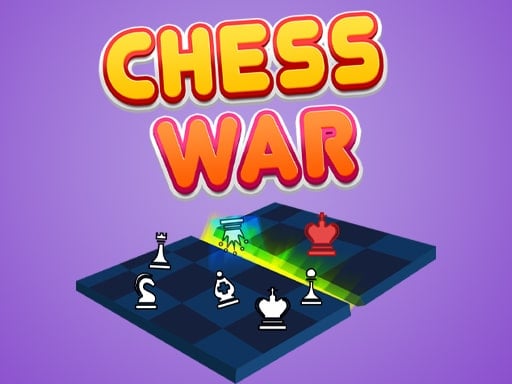
Chess War is a browser-based puzzle challenge where players maneuver a chess piece across a shifting board to reach a target red flag. Success requires moving according to standard positioning rules while dealing with physical obstacles that block your route. Because you must reach the destination without exhausting your allotted move quota, every turn demands careful forward planning and positional awareness.
Chess War combines traditional chess movement concepts with spatial problem solving. Rather than playing an adversarial match against an opposing army, your objective is to guide a chess piece across the board toward a designated red flag. Along the way, structural barriers obstruct direct lines of travel, forcing you to find alternative paths across the grid.
To solve these layout challenges, the game introduces dynamic board manipulation, allowing you to slide half of the board left or right to bypass blocked pathways. Every repositioning counts toward your overall move limit, turning the experience into a deliberate tactical exercise where careless steps lead directly to a loss.
Your goal
Your primary goal in Chess War is to successfully navigate your chess piece to the square holding the red flag while remaining under the maximum allowable move threshold. Losing occurs if you run out of moves before reaching the target, so you must calculate efficient paths around obstacles and use board-shifting maneuvers sparingly to preserve your turn count.
How to play Chess War
1. Inspect the board layout to locate your starting chess piece, the stationary obstacles, and the target red flag.
2. Review your remaining move budget to gauge how many total adjustments you can afford before triggering a loss.
3. Use your mouse to select and move the chess piece across valid grid positions according to the movement rules.
4. Slide half of the board to the left or right when obstacles block direct progression toward the goal.
5. Guide the piece onto the exact tile marked with the red flag to complete the challenge.
Controls and device support
Move the chess with the mouse by selecting and directing pieces across the board interface.
- Controls: Mouse or touch
- Device support: Browser
- Game frame: 1280 x 720
Rules to keep in mind
- The chess piece must navigate the board in accordance with established positional movement rules.
- Reaching the square containing the red flag is required to complete the objective.
- Physical obstacles placed on the board block travel and must be navigated around or bypassed.
- Players are permitted to shift half of the board left or right to clear a path past barriers.
- The total number of moves must be strictly managed; exceeding the move allowance results in a loss.
What makes the challenge interesting
The central appeal of Chess War lies in balancing route planning against board manipulation. Because ordinary chess maneuvers cannot penetrate solid obstacles, finding a solution requires visualizing how shifting half of the board alters alignment and open lanes. Every board adjustment and piece advance draws down your finite move pool, so players cannot rely on trial and error.
This structure shifts the game away from traditional combat and into tactical optimization. Instead of anticipating an opponent's counterattack, you focus on path economy, assessing whether moving the piece around an obstacle consumes fewer turns than shifting the board sections directly.
Tips for Chess War
- Count steps before moving: calculate the total turns needed for both piece advancement and board shifts before executing your first mouse click, preventing accidental move exhaustion.
- Evaluate board shifts early: check whether shifting half the board immediately creates an unbroken route toward the red flag, avoiding wasted lateral moves around stationary barricades.
- Avoid backtracking: retracing your steps unnecessarily consumes valuable moves from your budget; pause to confirm your trajectory rather than correcting mistakes on the fly.
- Respect movement constraints: always verify that your intended tile aligns with standard chess travel rules before committing your turn, ensuring you do not run into dead ends.
Playing on different devices
Chess War is designed to run in desktop browser windows at an internal display resolution of 1280 x 720. Mouse input is the primary method for selecting pieces and interacting with board controls, providing stable point-and-click accuracy needed for careful puzzle steps.
The skills behind the game
Although distributed under arcade and clicker labels, Chess War operates primarily as a grid-based spatial puzzle. Traditional clickers emphasize repetitive tapping to accrue incremental resources, whereas Chess War focuses on precision clicking, spatial deduction, and strict resource management where each individual click consumes a valuable move.
The arcade and war tags reflect its brisk turn pacing and thematic military motifs, placing players in a stylized tactical scenario where every positional decision directly impacts survival. This makes it an engaging choice for players who appreciate chess fundamentals reframed into short-form logic exercises.
Who will enjoy this game
Players searching for a chess war game typically seek tactical chess-inspired challenges rather than full length competitive tournaments. Chess War fits this casual practice niche by offering self-contained navigational puzzles that test understanding of piece geometry and spatial planning without demanding extensive opening theory.
Those browsing for a clicker game online will find that Chess War substitutes idle accumulation with deliberate mouse interaction. Because every move matters toward preventing defeat, the game provides a mentally stimulating alternative for casual puzzle fans looking to exercise analytical thinking in quick, focused sessions.
Frequently asked questions
What is the main goal in Chess War? The main objective is to navigate your chess piece across the board to reach the red flag according to piece movement rules, all while staying within the allowed move limit.
How do you get past obstacles blocking your path? You can maneuver your piece around them or shift half of the board left or right to realign tiles and open new routes toward the flag.
What happens if you run out of moves in Chess War? The game requires you to limit your moves; if you exceed the permitted number before reaching the red flag, you lose the game.
What controls are used to play Chess War? Chess War uses direct mouse input to select and move the chess piece across the board grid.
Something not right?
Tell us if the game does not load, the information is wrong or the content needs review.
Report a problem ›