About BlockFit Puzzler
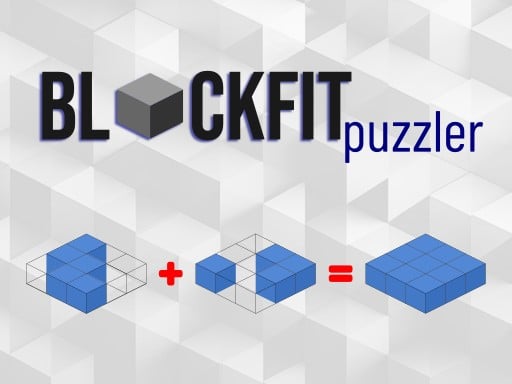
BlockFit Puzzler is a spatial reasoning puzzle game where players align upper-layer blocks with lower-layer patterns viewed from an isometric perspective. By removing unnecessary cubes, you reshape the top formation until it corresponds with the underlying target shape across board sizes from 3×3 up to 5×5 grids.
In BlockFit Puzzler, each level presents a visual logic test arranged in an isometric 3D view. The central challenge requires players to inspect a target pattern on the bottom layer and adjust the upper layer of blocks so that both layers match cleanly. Because the action involves touching or clicking to remove cubes, solving a board is a process of deliberate deduction rather than rapid reflex testing.
The puzzles scale in complexity as grid dimensions expand from compact 3×3 setups up to intricate 5×5 arrangements. This increase in grid size adds more cubes to analyze, prompting players to carefully track row, column, and height alignments from the angled camera perspective.
Your goal
The primary objective is to strategically remove cubes from the upper layer so the remaining block layout matches the target pattern displayed on the lower layer. Completing each board successfully allows you to advance through progressively larger and more complex grid stages.
How to play BlockFit Puzzler
1. Examine the lower layer to identify the exact pattern and footprint you need to replicate.
2. Survey the upper layer from the isometric angle to see which cubes currently exceed or conflict with the base template.
3. Touch or click the specific cubes in the upper structure that must be removed.
4. Verify that all remaining upper blocks align precisely with the lower pattern to complete the stage.
Controls and device support
The primary interaction stated in the instructions is touching or clicking to remove cubes from the structure.
- Controls: Mouse or touch
- Device support: Desktop + mobile
- Game frame: 720 x 1280
Rules to keep in mind
- Upper-layer blocks must be configured to match the pattern shown on the lower layer.
- Interacting with cubes removes them from the upper formation.
- Puzzle layouts range in dimension from 3×3 grids up to 5×5 grids.
What makes the challenge interesting
The core gameplay focus of BlockFit Puzzler centers on isometric spatial visualization and deductive subtraction. Rather than assembling a structure from separate loose pieces, players assess a pre-existing cluster of blocks and systematically eliminate the excess elements. The isometric viewing angle tests your ability to interpret depth and coordinate positions accurately across multiple axes.
Success relies on methodical evaluation before taking action. Removing a cube changes the visible silhouette of the top layer, meaning players benefit most from cross-referencing individual grid positions against the foundation before committing to removals.
Tips for BlockFit Puzzler
- Scan the perimeter corners first. Comparing outer corner blocks between the upper and lower layers gives you clear anchor points before tackling central cubes.
- Isolate one row or column at a time. Breaking down 4×4 and 5×5 grids into single-line slices prevents visual confusion caused by the angled isometric view.
- Double-check empty lower spaces. Identify where the bottom layer has gaps, and prioritize clearing the corresponding upper cubes directly above those empty spots.
- Pause before removing adjacent blocks. Accidental taps can alter parts of the structure you intended to keep, so confirm your target cube position carefully.
Stages and progression
Progression in BlockFit Puzzler introduces increasing difficulty across stages as grid dimensions expand. Early levels utilize compact 3×3 grids that introduce the isometric alignment concept with fewer total blocks to manage.
As you advance toward 5×5 layouts, the higher volume of cubes and more complex lower-layer patterns demand deeper spatial tracking and sharper logical planning for each removal.
Playing on different devices
Designed with a 720×1280 portrait canvas, the game suits mobile touchscreens as well as vertically framed desktop browser windows. Direct touch controls allow intuitive tapping on specific cubes, while desktop users can interact accurately using standard mouse clicks.
The skills behind the game
Classified under puzzle and logical categories, BlockFit Puzzler emphasizes visual clarity and structural problem-solving. Rather than relying on fast-paced arcade reflexes, the title invites players to study static geometric arrangements and determine which parts must be trimmed away. Its educational and logical elements help sharpen everyday 3D perspective comprehension and grid-based deduction.
Who will enjoy this game
Players searching for an accessible puzzle game online often look for clean, grid-based challenges that provide clear visual feedback without complicated rule sets. The BlockFit Puzzler game fits this need by focusing on a single, well-defined mechanic: sculpting a top layer of cubes to match a base layer. Whether you have a few minutes for a quick brain teaser or want to work through larger 5×5 spatial puzzles, it offers a focused logical exercise in browser-friendly sessions.
Frequently asked questions
What is the main goal in BlockFit Puzzler? Your goal is to match the upper layer of blocks to the pattern shown on the lower layer by strategically removing unnecessary cubes from an isometric viewpoint.
How do grid sizes change throughout the game? Puzzles feature grid dimensions ranging from 3×3 up to 5×5, offering larger structures and more complex pattern comparisons as the difficulty increases.
How do you control the game on different devices? You interact directly by touching or clicking the cubes you wish to remove, making the title straightforward to play on both mobile touch devices and desktop web browsers.
Is BlockFit Puzzler suitable for casual logic practice? Yes. The combination of spatial pattern matching and modular grid sizes makes it well suited for players who enjoy relaxing, visual brain teasers that test 3D perspective reasoning.
Something not right?
Tell us if the game does not load, the information is wrong or the content needs review.
Report a problem ›