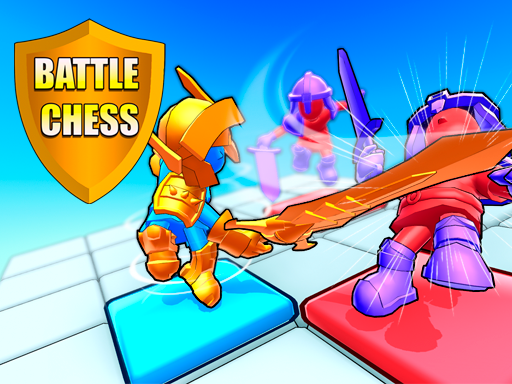
About Battle Chess: Puzzle
Battle Chess: Puzzle is a turn-based tactical sliding puzzle where you merge allied knights to gain strength and defeat opposing pieces across the board. Every move shifts your units while opposing pieces respond simultaneously, requiring careful spatial planning and calculated piece sacrifices to clear the arena.
In Battle Chess: Puzzle, traditional piece battles meet the sliding mechanics popularized by numeric grid games. Players shift their knights across the play area to combine identical or compatible units, boosting their overall combat strength before clashing with hostile pieces.
The opposing side does not stay passive; enemy units reposition whenever you slide your knights. To survive and conquer each board, you must predict hostile movement, prevent adversary pieces from merging into stronger threats, and leverage surrounding obstacles to secure advantageous matchups.
Your goal
The core goal in Battle Chess: Puzzle is to eliminate opposing pieces by building superior combat power through unit merges. You succeed by attacking hostile knights whose strength value is less than or equal to your own, clearing the board through smart positioning and tactical trades.
How to play Battle Chess: Puzzle
1. Observe the starting positions and numerical strength values of both your knights and enemy units on the board.
2. Swipe across the grid to shift all of your knights in a chosen direction, mirroring sliding puzzle movements.
3. Slide matching friendly units into one another to merge them, steadily raising your knight strength.
4. Monitor enemy movement after each slide to prevent opposing knights from combining and growing too powerful.
5. Direct your strengthened knights into enemy pieces that have equal or lower strength to defeat them in battle.
6. Sacrifice lower-value pieces or use environmental barriers when necessary to maneuver into winning board positions.
Controls and device support
According to the official instructions, controls function like 2048 where swiping sideways shifts all knights across the grid simultaneously.
- Controls: See in-game controls
- Device support: Browser
- Game frame: 960 x 600
Rules to keep in mind
- Sliding inputs move all friendly knights across the board in the chosen direction at the same time.
- You can only successfully attack and defeat an enemy knight if your attacking knight's strength is greater than or equal to the target's strength.
- Enemy chess units shift their positions in response as you make your moves.
- Allied pieces combine upon collision to increase their total combat power.
What makes the challenge interesting
Battle Chess: Puzzle revolves around simultaneous spatial management and arithmetic risk calculation. Because every input shifts every active unit on your side, moving toward an upgrade on one flank might displace a vulnerable piece on the other. Players must balance aggressive strength growth against defensive positioning.
The tactical tension comes from managing opposing counters. Since enemy units move in tandem with your actions, careless sliding can inadvertently feed opposing pieces into advantageous merges or leave weaker knights exposed. Success requires calculating two or three moves in advance rather than simply chasing immediate merges.
Tips for Battle Chess: Puzzle
- Check enemy strength numbers before committing to an attack. Attempting to strike a knight with superior power will backfire, so ensure your attacking piece meets or exceeds their value.
- Watch enemy trajectories to disrupt their combination opportunities. Allowing opposing knights to collide and merge makes clearing the board significantly more difficult.
- Use board boundaries and terrain obstacles to align your units. Sliding against fixed borders helps group your pieces together without scattering them across open lanes.
- Consider intentional piece sacrifices when a weaker knight is blocking a high-value merge line or trapping your strongest unit in an unfavorable corner.
Stages and progression
As board layouts evolve, puzzle arrangements introduce tighter maneuvering space and more complex enemy placements. Players can progress steadily by developing disciplined scanning routines, checking relative piece strengths across the entire board before executing each movement.
Building consistency across rounds involves refining your opening sequences. Focusing early turns on consolidating friendly pieces in safe sectors provides the strength reserves needed to dismantle reinforced enemy formations in the late stage of a puzzle.
The skills behind the game
Sliding merge puzzles occupy an engaging niche within browser puzzle games, challenging players to balance spatial planning with incremental math growth. By blending chess-themed arena combat with sliding board mechanics, Battle Chess: Puzzle reframes standard piece maneuvering into an active contest of power scaling and zone control.
Unlike static tile matching, games featuring reactive opposition require ongoing adaptation. Every shift on the board alters both offensive opportunities and defensive liabilities, rewarding deliberate play and foresight over quick, uncalculated reactions.
Who will enjoy this game
Players looking for an engaging merge puzzle game online will find that Battle Chess: Puzzle combines familiar sliding mechanics with competitive tactical combat. Instead of merely chasing high numbers on an empty board, each merge directly influences your survivability against hostile units.
This setup makes the title well suited for casual puzzle enthusiasts wanting quick strategic sessions. Practicing piece positioning, anticipating counter-movements, and managing unit trades offers a satisfying mental workout without demanding complex interface mastery.
Games with a similar feel
2048: 2048 focuses on pure numeric consolidation on a peaceful sliding grid, where tiles combine upon contact until no moves remain. Battle Chess: Puzzle adopts a similar all-unit sliding movement style but introduces combat objectives and active enemy pieces that move alongside you, shifting the experience from endless number building to a tactical martial puzzle.
Frequently asked questions
How do combat encounters resolve in Battle Chess: Puzzle? Combat depends directly on piece strength. A knight can attack and defeat an enemy knight as long as its strength number is greater than or equal to that of the opposing piece.
Do enemy pieces move on their own turns? Hostile pieces move reactively in coordination with your inputs. Every time you slide your knights across the grid, the opposing chess pieces adjust their positions accordingly.
Can enemy knights also merge to gain strength? Yes, enemy knights can merge if given the opportunity. Preventing enemy combinations is a core tactical objective while you work on strengthening your own forces.
Something not right?
Tell us if the game does not load, the information is wrong or the content needs review.
Report a problem ›