About 3D Isometric Tiles
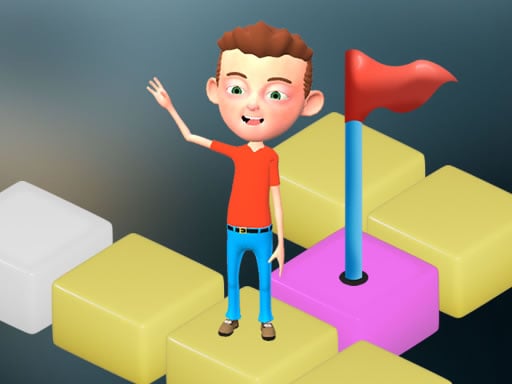
3D Isometric Tiles is a spatial logic puzzle where you navigate a character across floating elevated platforms. Your goal in every stage is to guide your piece across every yellow tile, causing each one to drop away, before finishing on the final purple destination block. Success requires visualizing the entire route in advance so you do not leave isolated tiles behind or trap yourself on disconnected ledges.
In 3D Isometric Tiles, players face grid-based board configurations presented from a classic isometric viewpoint. Each level presents a distinct layout composed of individual stepping blocks. As you command your piece across the structure, stepping off any yellow block causes that platform to fall away to the ground below. This mechanic means every yellow step is strictly one-way, removing return paths and altering the walkable geography with every move you make.
The core loop revolves around route planning, spatial orientation, and clean execution. To solve each layout, you cannot simply rush toward the exit; you must ensure that every single yellow tile has collapsed while ending your sequence squarely on top of the purple goal tile. The isometric perspective challenges your depth perception and pathfinding intuition, rewarding thoughtful planning before making your opening movement.
Your goal
The primary objective is to solve each level layout by dropping all yellow blocks to the ground and positioning your character on the purple block at the conclusion of your route. Completing a puzzle requires a continuous, comprehensive traversal where no yellow tiles remain standing and your character never becomes stranded without a valid path to the purple target.
How to play 3D Isometric Tiles
1. Study the entire isometric board layout before making your first move to locate the starting position, all yellow blocks, and the purple goal tile.
2. Swipe or tap to move your character onto an adjacent isometric block.
3. Step off yellow blocks along your planned line, allowing each one to fall away behind you.
4. Follow your chosen sequence until every yellow block on the board has dropped to the ground.
5. Conclude your movement path directly on the purple block to complete the stage.
Controls and device support
The game accepts touch swipe gestures or mouse clicks and taps to move your character between adjacent isometric blocks.
- Controls: Mouse or touch
- Device support: Desktop + mobile
- Game frame: 720 x 1280
Rules to keep in mind
- Stepping off a yellow block causes it to immediately fall to the ground.
- Every yellow block on the board must be dropped to the ground to successfully solve the puzzle.
- The player must finish the movement sequence standing on the purple block.
- Movement proceeds block-by-block across adjacent connected tiles.
What makes the challenge interesting
The primary cognitive challenge in 3D Isometric Tiles comes from combining single-stroke pathfinding with an angled isometric viewpoint. Because every yellow block you leave disappears permanently, each decision burns a bridge. You cannot backtrack across previously visited tiles, turning what might look like an open grid into a rapidly shrinking maze.
This setup creates a deliberate tension between clearing peripheral tiles and maintaining an open line to the purple finish. If you advance directly toward the goal too early, you risk stranding outer yellow blocks on isolated branches. Conversely, winding through every corner requires precise calculation so your final step naturally lands on the purple block rather than a dead-end drop.
Tips for 3D Isometric Tiles
- Trace your path backward starting from the purple finish block. Working in reverse helps identify the mandatory final approach and reveals which peripheral yellow tiles must be visited early in the run.
- Clear dead ends and outer spurs first. A common mistake is leaving a single yellow tile on an isolated edge, making it impossible to clear later without cutting off your escape route.
- Count remaining yellow tiles as you plan your route. Ensuring your mental line covers every single block prevents reaching the purple tile prematurely with leftover pieces still floating.
- Pause before inputting rapid swipes. Rushing moves often leads to misdirected steps along isometric diagonals, accidentally triggering an unintended block drop and spoiling a viable solution.
Stages and progression
3D Isometric Tiles structures its experience across distinct level layouts, each presenting a fresh arrangement of isometric stepping blocks. As you progress from stage to stage, board shapes require finding secret paths that account for more complex branching paths and intricate platform geometries.
To handle later stages effectively, develop a consistent problem-solving routine: scan the board for bottlenecks, isolate one-way spurs, and verify that your route terminates exactly on the purple destination before executing your moves.
Playing on different devices
Designed with a vertical 720 x 1280 resolution, the game is naturally suited for portrait screens on mobile devices where directional swipes offer direct tactile control. On desktop browsers, players can use mouse clicks or taps to guide the character across the isometric grid without needing keyboard bindings.
The skills behind the game
Positioned within the logic puzzle and skill genre, 3D Isometric Tiles emphasizes methodical deduction over quick reflexes. Single-stroke traversal games challenge players to calculate complete traversal routes under strict constraints where each step alters the available playing area.
By shifting the familiar grid maze into an isometric 3D space, the game exercises visual orientation and forward planning. Players who enjoy spatial puzzles and sequential logic challenges will find a focused test of path optimization in every layout.
Who will enjoy this game
Players searching for 3D isometric tiles games and browser-based logic challenges look for accessible titles that test geometric problem-solving without steep setup barriers. This game delivers immediate pick-up-and-play mechanics suitable for short mental exercise sessions or casual puzzle practice.
Because every stage is self-contained, engaging with online puzzle games of this type offers a rewarding way to practice visualization, step sequencing, and error prevention during daily breaks on mobile or desktop.
Frequently asked questions
What happens when you step off a yellow block in 3D Isometric Tiles? When you leave a yellow block, it immediately falls down to the ground. That tile is permanently removed from the active path, preventing you from stepping onto it a second time.
Can you finish a level if some yellow blocks remain standing? No. To complete any puzzle, all yellow blocks must be dropped to the ground and your player must end the sequence standing directly on the purple block.
How do you control movement in the game? You can swipe your finger across the screen on touchscreen devices or use mouse clicks and taps on desktop browsers to navigate between connected isometric blocks.
Something not right?
Tell us if the game does not load, the information is wrong or the content needs review.
Report a problem ›